The Emotional Cycle of Change
Why is it so difficult to change, even when it’s something you really want? You know how this goes… You hear about a new business or a new lead generation strategy, or new shiny object that promises to solve all your problems.
And buddy, you get excited….
You’re on fire with enthusiasm! Let’s do this!
For a hot minute…
Until reality sets in…
And the fire goes out…
Uh oh, maybe this is gonna be harder than I thought…
Ever been there? I know I have.
I’m going to walk you through some fascinating science I discovered on this. I’m going to show you the stages we all go through emotionally when changing behavior.
(Because we all go through stages of optimism and pessimism in business, right?)
But I have found that once you’re aware of these five stages, you’re much better prepared to push through to success. If you’re struggling right now in business, this might just give you that extra fuel you need.
This lesson is short, but extremely valuable. Let’s get started.
Everyone Must Do the Pipeline, Not all CAN … (Yet)
If you’ve been following along in this series of videos, I’m trying to get everyone to the Pipeline.
The Pipeline is whatever business in the world has to do in order to get business of any kind: to hire people, to get votes, to get a congregation at the church. To get clients or customers, every business is required to do the steps of the Pipeline.

In my latest video series, I’ve been talking about the “bridge” to the Pipeline. I’m building a bridge to the Pipeline because there are people who have difficulty in implementing the steps in the Pipeline.
The topics covered in the “bridge” are things you need to know and do, before you can have success using the Pipeline.
Today’s video falls in the second step, “Carve out the space so you can get focused and productive.” And part of that has to do with change.
The last two videos that I’ve done:
Seven Day Reveal – You need to confront exactly what you really are doing.

And then Breaking Bad Habits – I share my experience that taught me that I could change.

And then this training, The Emotional Cycle of Change, you will learn how to overcome the things that are hard to do or adapt to, and change to get better and better.
This is the Pipeline, and I want you to look at it just for a second, because when somebody is suddenly required to generate a lead, they’re kind of like, “What?!… this is not normal behavior, this is not a normal operating basis for me. What do I even do?”

When someone in network marketing asks this type of question, that means that they’re going to have to change what they’re doing.
The only way a person can get more of what they want is by changing their actions. Their current actions are creating their current outcome. A person has to have the ability and willingness to change in order to get better.
It’s not hard to change to get worse, but it is harder to change to get better. But having said that, it’s not hard to change once you understand what I’m going to share in this training and the one that will follow this next week.
Four Truths About the Pipeline
1. All businesses must do the Pipeline.
2. You gain freedom (both income freedom and security freedom) when you can do the Pipeline.
I have been 34 years now with a six to seven figure income all those years. I started part-time. I went through the cycle of change. I retired for 18 years, and then I came back into the industry and I went through the cycle of change again. I’m very familiar with it, and it is very worthwhile to learn and know it.
3. All income in a company comes from sales reps doing the Pipeline. The CEO gets a 2 million dollar bonus at the end of the year; where in a world would they get that money? People who are doing the Pipeline is the only flow of income into a company. This is not unique to network marketing.
4. Some companies can reward sales reps a little, and some, a lot. In network marketing, we get paid a lot for doing the Pipeline correctly.
The Emotional Cycle of Change
Let’s talk about the emotional cycle of change.
What I want to focus on is optimism and pessimism. These are the emotional feelings that you will have.
And it’s good to know about this so that when you experience it, you can recognize what’s happening. This is what everyone has to go through at some point.
Do realize, it’s not “just you” that feels this way. You don’t want to introvert and start thinking about all kinds of crazy stuff.
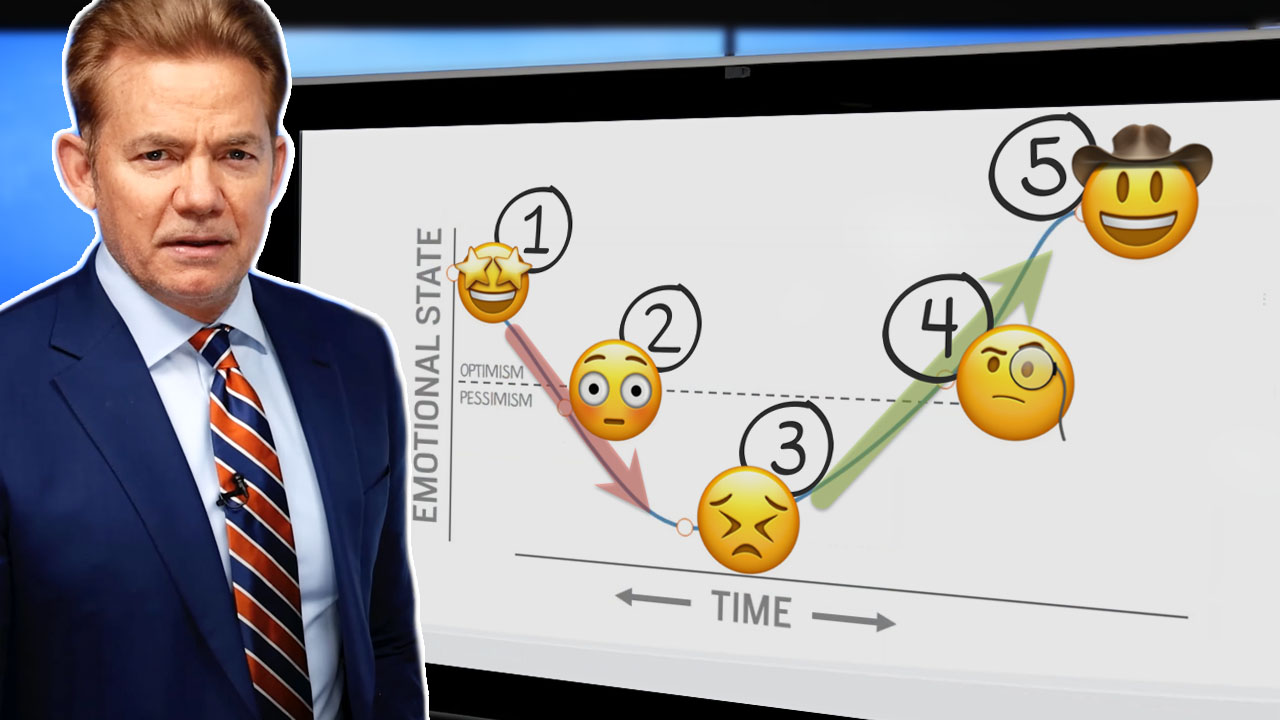
Phase 1: Uninformed Optimism
We start with Phase One and the Doctors called it “uninformed optimism.”
An example of this would be: Let’s say you went to a business opportunity meeting and they showed you the network marketing company. You’re sitting there and you’re like, “Wow, I never knew this!”
You’re fired up! You can see no downsides. All you see are lots of benefits, no downsides, loads of fun. Let’s do this! Like, why not?
This is uninformed optimism.
You don’t know what the change looks like. You don’t know what’s going to be experienced yet.

Phase 2: Informed Pessimism
And what I see happen often is that the emotional state rapidly falls to informed pessimism, which is Phase Two.
Now the cost of change is apparent. You’re starting to have doubts. Maybe this was a mistake. That’s what happens and it’s very early on.
Phase 3: The Valley of Despair
And then Phase Three is what the Doctors named “The Valley of Despair.”
Pain of change felt. Benefits seem less important. Life was easier before. And so the reason it’s called “The Valley of Despair” is because you’re in that quit stage.
You start having doubts at Informed Pessimism and then you hit that level down at Valley of Despair.
At that point, you have two choices.
If you choose to quit, then you’re going to take this route, which is you’re going to go back up to Uninformed Optimism at the next thing that you find.
You quit and then repeat phases one through three. As a result, you are always on this emotional cycle of getting fired up and then realizing it wasn’t what you thought or the cost of change was too much. You hit the Valley of Despair and then you quit and start again. And this is the essence of the shiny object syndrome.
Shiny Object Syndrome
So when people are always chasing that next thing…
Maybe it’ll solve it… Maybe that’ll solve it…I’m going to do this training…And this training… and this training…
That’s what this cycle looks like. But if you can say, “No… I see something here. I’ve set my vision and I’m going to move forward with it,” then you’re going to push through and you’re going to make a turn here.
Phase 4: Informed Optimism
When you can push through and make the turn is when you arrive at phase four, which is Informed Optimism. Here your chance of success is much better. It’s a positive emotional area.
You will see the benefits starting to bear fruit. New thoughts and actions become more routine.
It wasn’t routine before; it was all new. Before, you were having to create every single thing, nothing was familiar. But now you’re starting to see some change in it. Optimism is there.

Phase 5: Success and Fulfillment
And then all this can progress to the new plateau, phase five, Success and Fulfillment. Here, actions are now routine. The cost of change is virtually gone.
Completing the cycle and reaching this point builds capacity and confidence to grow more.
Notice how Phase 5 is higher on the emotional state line than Phase 1. This new plateau you reach in Phase 5 is needed, if you’re going to consistently get better and better and better.

This was the biggest “aha” for me when I learned this concept.
Capacity
Going through each level of emotion and reaching Phase 5 builds capacity. And what’s capacity?
I’m going to give it to you in a quote. I’ve never used a quote before, but there is a man that I highly enjoy reading what he has to say and that’s Vince Lombardi.
He had three NFL championship victories in Superbowl I and Superbowl II, (in 1967 and 1968.) Because of his success, he became a national symbol of single-minded determination to win.

Here is what he said:
“Winning is not a sometime thing. It’s an all time thing. You don’t win once in a while. You don’t do things right once in a while. You do them right all the time. Winning is a habit. Unfortunately, so is losing.”
The Habit of Winning
So if I go back and look at Phases 1, 2 and 3 – these are the habits of losing. And phases 3, 4 and 5 are the habit of winning.

At Phase 5, you’ll change again here to raise yourself up. You’ll still go through a valley of change where it’s just not quite right yet. You’ll have to figure out how to do new things that come your way. For example, like somebody comes out with a new strategy to generate leads. It could be good, or it might not be.
You have to really grip ahold of it, and learn all the techniques and the tactics. And that’s how you consistently get better and better and better.
The alternative is that you get into a cycle of failure where it just becomes a habit to fail. And hopefully because I’m sharing this with you and you can see what’s happening, that you will push through and rise on up to Informed Optimism (Phase 4) and then grow your capacity so that you’re forever growing your competence.

I know that this is truth because winning becomes a habit. I’ve experienced it.
And so with that, do me a favor and leave me a comment. What I’d love to hear from you is:
1. Recall a time that you changed successfully. How did that feel? Did you experience the capacity to change?
2. Recall a time that you resisted changed and quit. How did that feel?
Need help with your message? Here’s my training for what to say and how to say it. If you don’t have a team or haven’t recruited anyone (or less than 10 people), this is THE course you should get – Network Marketing Training Course