Can You Debate Network Marketing Statistics?
My question for you today is: is a statistic up for debate? If you’ve been around the network marketing industry, you’ve probably heard people say, “Most people fail,” or “90% fail.”
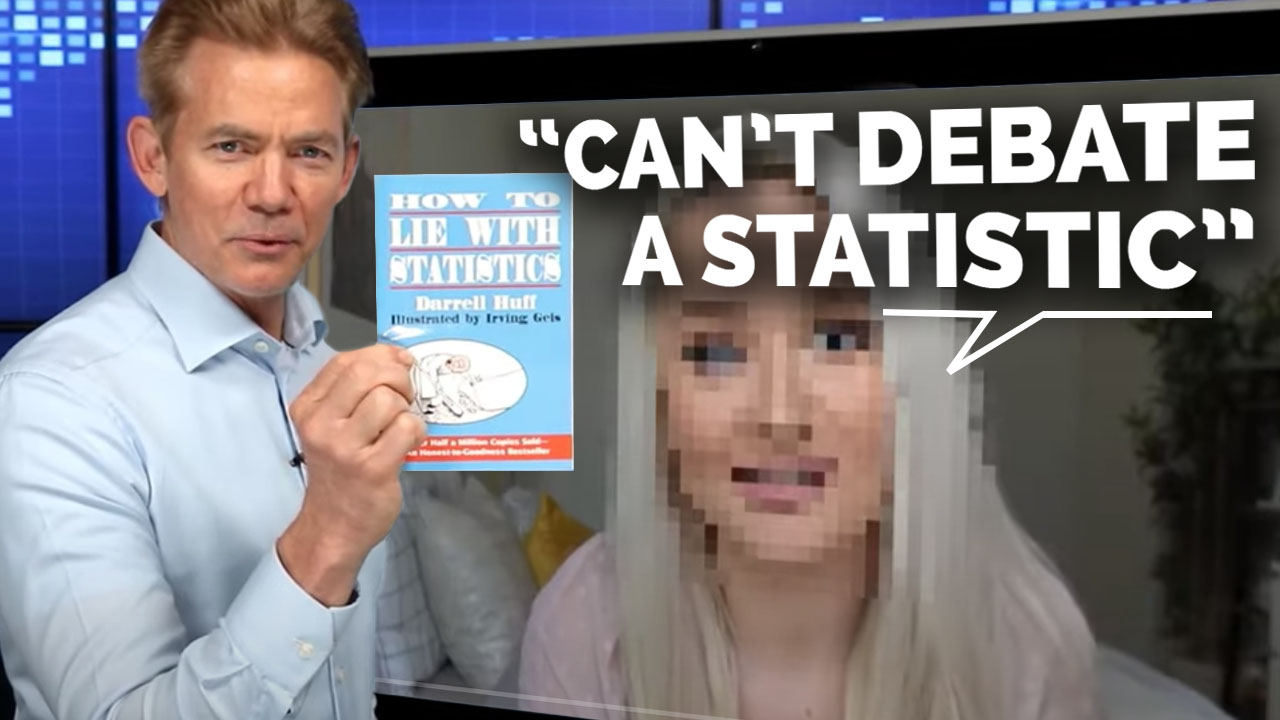
There is an anti-MLMer who says that you can’t debate a statistic.
In this post, I’m going to compare the income statistics of three different business models, one of which is network marketing, so make sure you read this all the way to the end.
I’ll start with a quote from Kylie where she says that a statistic is not up for debate. First, she plays a clip of a video of a girl talking about network marketing. The girl says:
“And that brings me to number two is that only 1% of people will be successful in this. I’m going to give or take that because I’m going to probably put it down to 90% of people that won’t succeed at this.”
Then Kylie adds her comment:
“First of all, you can’t give or take a statistic. You can’t. So it’s not about how you feel that day or anecdotal, whatever it is. You can’t. That’s a statistic. It’s not really up for debate. But then she says, ‘I’m going to pull it down to like a 90%’ Still not great. Even if we were to say, hypothetically, yeah, let’s go with your statistic. 90% of people fail. Still not great odds. It’s still not a great business venture to go on and I wouldn’t recommend it to anybody.”
Yes, she said, “I wouldn’t recommend it to anyone.” Keep that in mind.
How to Evaluate Statistics
I’m going to compare YouTuber statistics as well as network marketing and one other industry. The first thing I’m going to do is have you get a greater understanding of how a statistic actually can be debated.
The reason I’m doing these things is that I want to get you off of relying on another’s opinion. If somebody can’t evaluate something, they have to depend upon another’s opinion. Throughout all of my videos, I’m trying to educate you how to evaluate something, and this is going to be one of those epic educational pieces for you.
Throughout all of my videos, I’m trying to educate you how to evaluate something, and this is going to be one of those epic educational pieces for you.
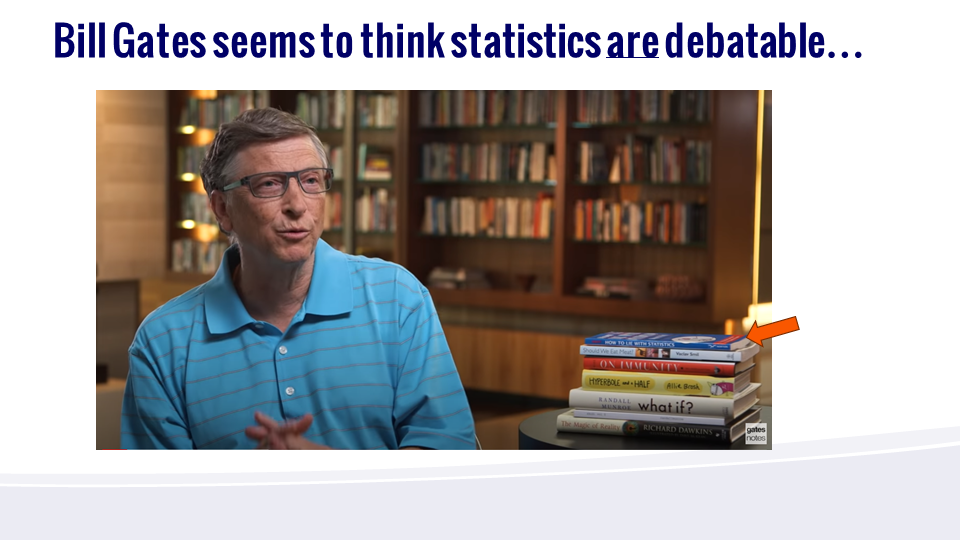
I happened to see that Bill Gates recommended a book called How to Lie with Statistics by Darrell Huff. I had to go buy it. I’m going to show you that statistics can be debated in many ways, and I’m going to cover three of them.
Omit a Comparison
The first one is to omit a comparison or compare it to a false equivalent. One example of that would be a document by John Taylor that every one of the anti-MLMers always quote. He compared network marketing to a traditional business. In the Small Business Administration statistics, the average loan for a person who is starting a small business is $380,000. That is what’s called a false equivalent You have to compare network marketing to something that is comparable.
Deceptive & Tricky Math
The second one is deceptive, tricky, made-up, pseudo math. What was calculated and how was it calculated? You’ve got to be able to look at the raw data. You do not look at summaries. You have to say, “How was the data put together?”
Subcomponents
The third one is that sub-component stats are a quantity of something. It’s not 1, 2, 3. It’s 1 apple, 2 apples, 3 apples. It has to be a quantity of something.
When somebody says, “90% fail,” you have to say, “At doing what?”
Understanding sub-components is how one can change a statistic instead of being the effect of a statistic.
What I mean by effect is saying, “Oh, well, I can’t do it because statistically most fail,” instead of digging down and saying, “What are they doing? What can’t 90% do?” You just never know that.
I was utterly baffled by Kylie’s statement. And it’s the reason I’m going to explain these things for you.
Here’s an example:
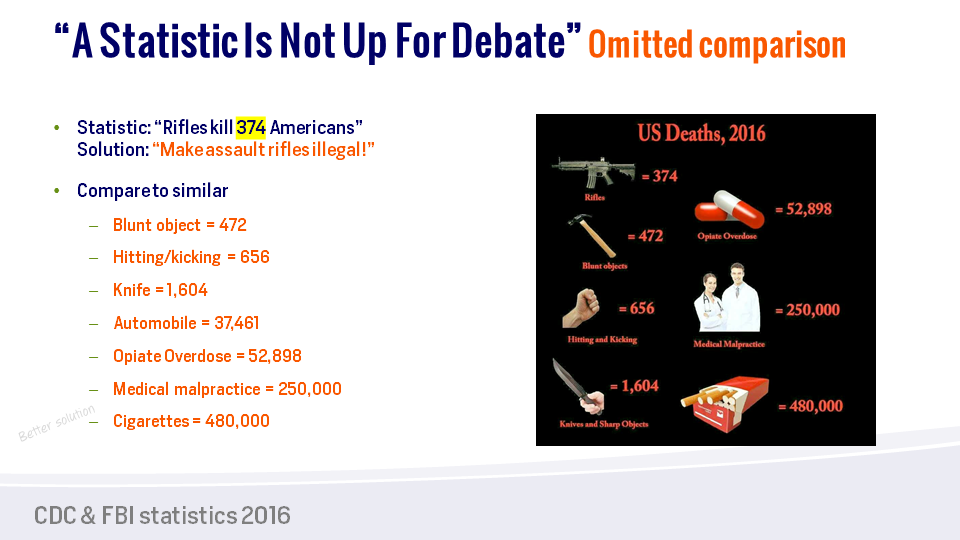
Statistic: Rifles killed 374 Americans.
Solution: “Oh no! Make assault rifles illegal!”
What’s the problem here? 374 deaths compared to what? The problem is omitting a comparison.
- If you compared it to a blunt object, such as a hammer, 472 were killed.
- 656 were killed by hitting and kicking. You’re going to have to get rid of everybody’s hands and feet.
- 1600 people were killed by knives
- 37,000 by automobiles
- 52,000 by opiate overdose
- 250,000 by medical malpractice
- 480,000 by cigarettes.
Why start with what kills the least? You start with the bigger number and work backwards. Do you see how you can lie with a statistic by omitting a comparison?
Here’s an example of the deceptive math statistics:
Statistic: 480,000 men were studied for seven years. 24% reduction in heart attack-related deaths.
“Oh, wow! 24% of 480,000! That’s 115,000 people whose lives were saved.”
It’s not what it is. Where did this 24% come from? You will not see it in the abstract. You will not see it in the summary. You have to dig into the actual quantities.
What you will find is that in the placebo (sugar pill) group, 38 people died, and in the statin drug group, 30 people died – a difference of eight. If you look at the percentage of that, in the placebo group 2% died. In the drug group 1.6% died. It’s 2% versus 1.6%. The difference between 2% and 1.6% is .4%. .4 is 24% of 2. It’s a reduction. The 24% is a ratio of a ratio. That’s deceptive math. So yes, you can debate a statistic.
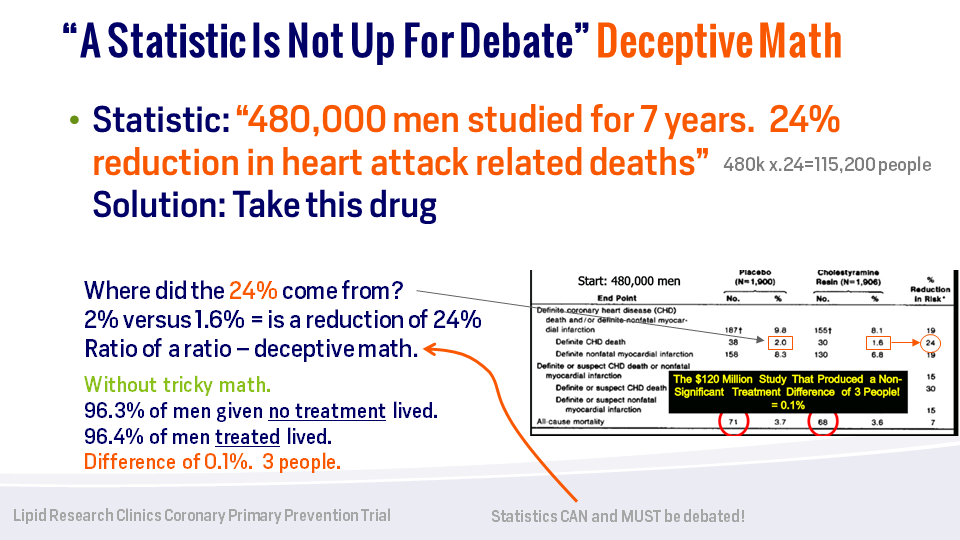
If you don’t do tricky math and you look at the raw numbers, you’re going to find something fascinating.
96.3% of men given no treatment lived, and 96.4% of men given treatment lived.
That’s a difference of 0.1%, or three people in a study of 480,000 people. That is called a non-statistical event.
The only way that they were able to get the traction they got was by doing deceptive math. If anybody had looked at this, they would have said, “Three people? Are you kidding? Out of that many?” They spent $120 million on this study, or the taxpayers did. Now can you see how with this deceptive math, you can lie with statistics?
Now I’ll show you an example of the third one: omitted quantity, comparison, and factors.
Statistic: 90% lost money in MLM. The solution is don’t do MLM or quit.
No quantity. How much money did they lose? Compare quantity to real estate agents, insurance agents, affiliate marketers, Amazon sellers, stock trading, YouTubers, et cetera, then, and only then would you be able to look at it.
As a comparison, $4.6 trillion were lost in four days in the stock market. Losing money is a good reason to quit, but how much money was it? What were the expenses or net loss? That’s the other thing that they don’t ever mention.
And this is no comparison. Almost all legitimate network marketing companies that I know of offer 100% return within 30 days of purchase, and 90% return within 365 days.
Another point of comparison is, “Was it 1099 income?” Because you write off your expenses for 1099 income. W2 income is poor people income. It’s automatically taken out of your paycheck. Your employer takes it out, and it’s, on average, 40% of your income.
In a network marketing business, the average person saves $4,000-$8,000 on taxes by having a network marketing business, if the person or their spouse is a W2 income earner.
Somehow you had to pay for the leads you bought. Where did you have the money to pay for that? That money is typically W2 income. You can write off whatever it was that you spent because the IRS has two tax systems: W2 for poor people, and 1099 for wealthy people, the people who are going to open businesses and create wealth. You can write off running ads for your business. You can write off business expenses.
Did this person who said, “90% lost money in MLM” look at all the factors? Did they look and say, “Did that person write that off their taxes?” Then it wasn’t actually a loss to them.
Comparing Network Marketing with Other Industries
Now let’s do some comparisons. Real estate startup expenses are very similar to those of network marketing.
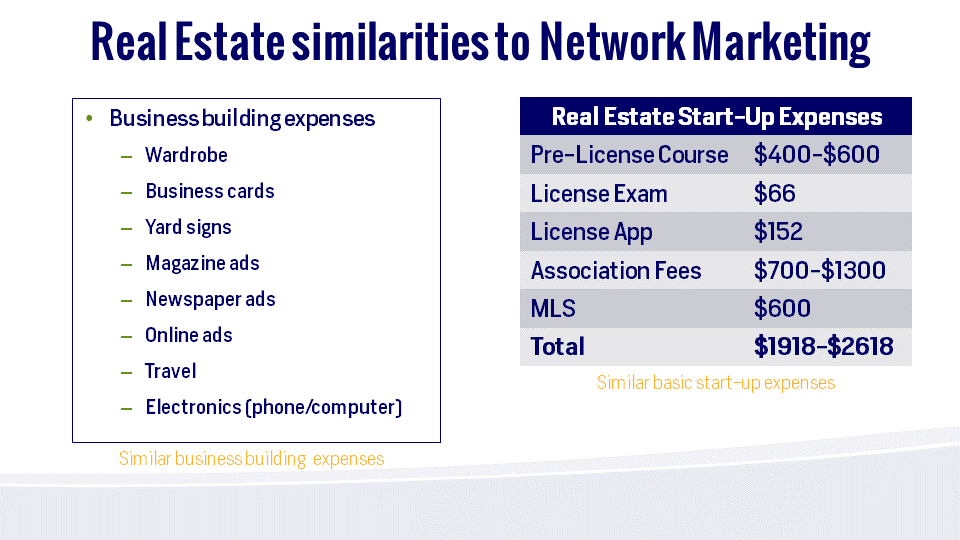
- It’s $500-$600 to do a pre-license course
- The exam is $66
- The license application is $152
- The association fees are around $1,000
- The multiple listing service is about $600.
So, it’s a total of $2,000-$2,500 for the basic startup cost. There are also business expenses, wardrobe, business cards, yard signs, magazine ads, newspaper ads, online ads, travel, phone, and computer. This is similar to the business expenses we incur.
In the John Taylor document that so many anti-network marketing people reference, including Kylie, he compares us to a business. The average loan to start a business, according to the Small Business Administration, is $380,000. That is not a comparison. A person who puts $380,000 into a business is very different minded and devoted, or else they will have to file bankruptcy. Coming up, I’ll do another post where I can really give these comparisons a lot of explanation.
What I’m going to show here is that the real estate industry fundamentally starts their math with the number of people who pass the exam. They omit all of the attrition from when a person says, “I want to be a real estate agent,” up through passing the exam.
By the time you get down to where there are 50,000 new agents every year, only 7% are remaining. Their math starts where 93% have been omitted. That is why you have to debate a statistic.
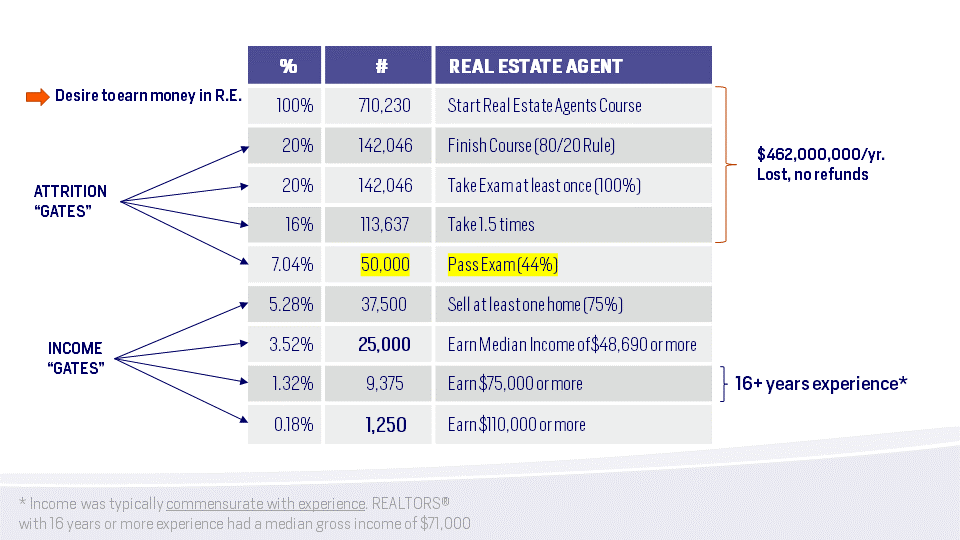
It actually required 700,000 people in order to get 50,000 to pass the exam. Out of those 50,000 people, how many sell one home? 37,500. In network marketing, 578,000 are going to sell at least one product. Obviously it’s easier to sell a network marketing product than it is to sell a home, but we have a big drop right here.
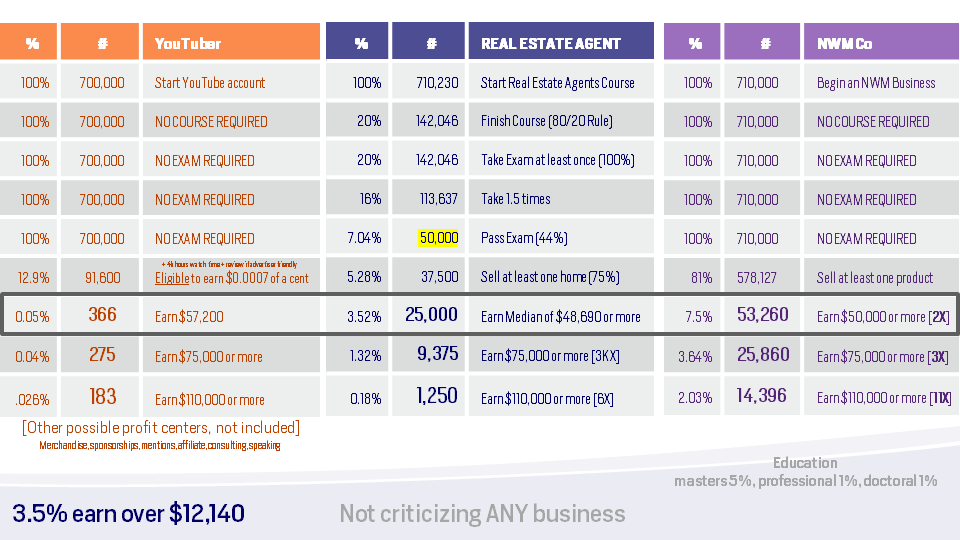
Now let’s compare network marketing to Kylie’s numbers. She is a YouTuber. Only 12.9% of YouTubers get to being eligible for 1/7th of one penny. They have to have 1,000 subscribers and 4,000 watch hours. I’ve never heard of a compensation plan in my life that works that way.
In YouTube 0.5% of the people earn $57,000, in real estate, 3% earn $48,000, and in network marketing, 7.5% earned $53,000.
Two times more people will earn $50,000 in network marketing than in real estate.
Then, only 0.04% of YouTubers (Kylie’s industry) will earn $75,000, 1.32% of people in real estate (about 9,000 people) will earn $75,000, but in network marketing, 25,000 people from the same starting number earn in the $75,000 bracket. That’s almost three times more than in real estate.
When you get into the $100,000 range, only 0.02%, or 683, YouTubers are going to make $110,000, 0.18%, or 1,250 people in real estate will make in that range, and in network marketing, 2%, or 14,000 people will make $100,000. That’s 11 times more.
Eleven times more people will earn $100,000 in network marketing than in real estate.
I’m not cutting down real estate. I’m not cutting down YouTubers. I never want this to be about that. Any person who is stepping out there and saying, “I want to be an entrepreneur,” is in our tribe, so I don’t ever want to cut anybody.
I’m only doing this comparison because John Taylor has made a point that so few people make money in network marketing, and he’s only gotten away with it for one reason: he omitted a comparison with other businesses.
The Subcomponents of Income
Now let’s talk about sub-components. Statistics are a quantity of something. If you’re not looking at the sub-components of a statistic, you’re not looking at what they’re counting. What are the sub-components that went into the statistics? These are the sub components of income:
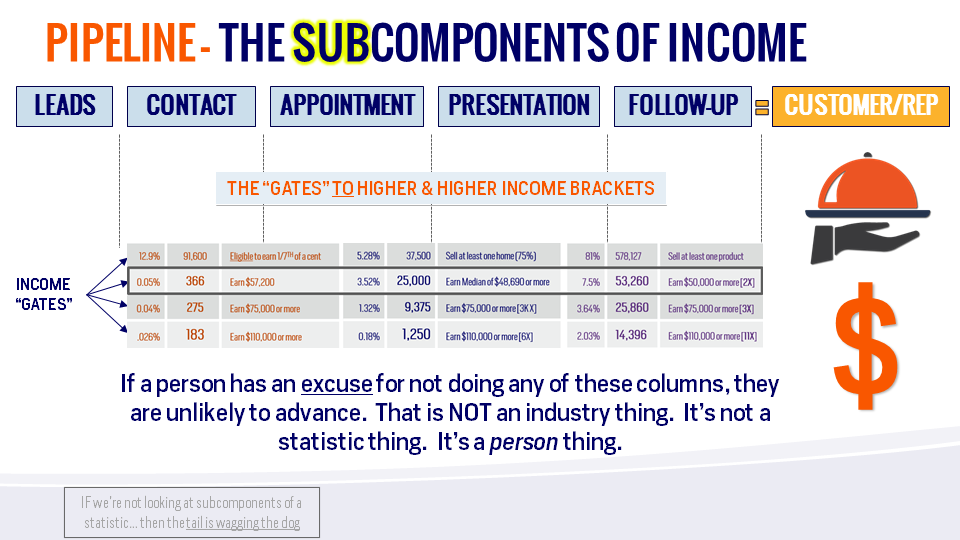
This is what I call the income gates. What is the difference between, let’s say in network marketing, a person who sells one product versus a person who builds a sales team versus a person who builds a bigger sales team versus a person who builds an even bigger sales team?
The difference is the pipeline, the subcomponents of income: Leads, Contact, Appointment, Presentation, Follow up and Serve your customer or rep. That’s all that it is!
Guess what the pipeline is in real estate? The same. Guess what it is in YouTube? The same; they just go about generating their leads in a different way. They’re called subscribers in that situation. So that’s the main thing that differentiates income.
If you look at these numbers, you might say, “Am I really that good? Wow, I’ve never thought of myself as being in the top 5%.” I assure you, I never looked at statistics when I started building. It never came into my mind. I knew I was shy and I had to get over talking to people or how to generate leads. I’d never written an ad in my life. I put ads in the Washington Post newspaper. And so it was kind of crazy to me when one day I found out I was in the top 1%. The reason I say it that way is that I was only focused on doing these columns. I wasn’t focused on trying to get to 3% or 2%. That wasn’t what I was about. I was just trying to do the pipeline.
If a person, and I’m talking primarily here about the income gates, has an excuse as to why they can’t generate a lead, or do any one of these steps of the pipeline, they are unlikely to advance.
If there was one excuse that holds a person back from any of these income gates, that’s it. This is not an industry thing. It’s not a statistic thing. It is a person thing.
For John Taylor to blame it on an industry tells me all I need to know: he wasn’t doing this pipeline. We were in the same company at the same time. One of us went on to make a six to seven figure income for 31 years, the other one spent his life trying to prove that the industry is wrong.
That’s what happened.
Is the Tail Wagging the Dog or the Dog Wagging the Tail?
If you don’t do the steps in the pipleline, then what we have is what I call the “tail wagging the dog.” The tail in this conversation would be the statistic. Is the statistic wagging the human?
In other words, “Only 2% make it to $100,000 in network marketing, so I can’t.”
No! That’s not the way it goes!
You see the human spirit is what controls. It’s the dog, the spirit of the dog that wags his tail when he’s happy. That’s the difference. You cannot look at a statistic and say, “That statistic controls me.” No, it doesn’t. It only does to the extent that people use it to put a person down and make him think that he can’t do it.
You cannot look at a statistic and say, “That statistic controls me.” No, it doesn’t. It only does to the extent that people use it to put a person down and make him think that he can’t do it.
I’m a little fired up about this. I don’t like when somebody suppresses another person. It ticks me off because a coward makes other cowards, and I don’t like it.
Let’s get back to what Kylie said: “You can’t give or take a statistic.”
Yes, you can. At a minimum, compensation plans are different from company to company. How do you think John got his numbers? The companies didn’t give them to him. That’s not how he got his numbers. He did algebra to try to figure out how much payout there was. You’re not going to get it that way.
It’s very hard to come up with the actual payout, because some compensation plans combine company conventions, incentive trips and various other things. Others have caps. His numbers weren’t accurate. So you must look at the actual statistics.
Kylie said, “A statistic is not up for debate.”
Oh yeah. It is.
Kylie said, “If 90% fail, still not great odds, still not a great venture. And wouldn’t recommend it to anyone.”
What a hypocrite. Kylie’s business fits what she speaks against. In fact, Kylie sits in between $10,000 and $100,000, which puts her in about the top 2% in her business. She is in that top category that she’s saying she wouldn’t even recommend to anyone, yet she’s doing it.
The fact that she didn’t debate a statistic, that she didn’t read John Taylor’s document with a curious mind, instead of with a bias and already having made up her mind, is where she made her mistake.
When Reps Are Confronted by a Statistic
She made a comment in another video that I’m going to quote for you now. In it, she says:
“When people are confronted with a statistic that is true or a fact or something that contradicts what they believe, and then they turn to ad hominem logical fallacies as a way of arguing…” (that is when you attack the person, instead of the point that the person is trying to make.) …”It’s been researched by the FTC, warning people not to join these types of things and people still do them. So the more we can get these statistics out, then the better.”
What I want to draw to your attention here is that Kylie said, “…confronted with a statistic that is true…” but I ask, compared to what?
If you compare it, you get that relative factor to say, “Yeah, but it’s better than real estate.” Even if it was equal to real estate, I would have other factors to consider.
This is just an example, but for easy math let’s just say it takes 400 houses to make $100,000. And if the real estate agent sells 400 houses one year, the next year he’s going to have to sell 400 more houses, and the year after that he’s going to have to sell another 400 houses. In network marketing, our income is more residual. Unlike a real estate agent who has to keep selling houses to get paid, in network marketing, once I get a customer I am paid month after month, for the life of that customer. That’s what I mean by residual.
Another factor would be, I also have a team. It’s not just me. I’ve got an organization that is assisting in this. I’ve got geographic diversification and markets.
If you’re in a small town, like I’m in, and you’re a real estate agent here, probably only two houses a year are going to go up for sale because it’s a small area. If you’re a real estate agent licensed in Utah, you’re not selling in different states or in other countries.
I will always prefer network marketing for this very reason because I can build my business all over the globe; I am not confined to one specific area.
Another thing Kylie said was, “It’s been researched by the FTC.”
This is another one where Kylie made a mistake because she was unwilling to debate a statistic. When she claimed that this “90% of people fail in network marketing” statistic was “researched by the FTC” she did not notice that the research was in the public comment section. Just like somebody comments on my videos and blog posts, or comments on her videos, there are public comments of the FTC website.
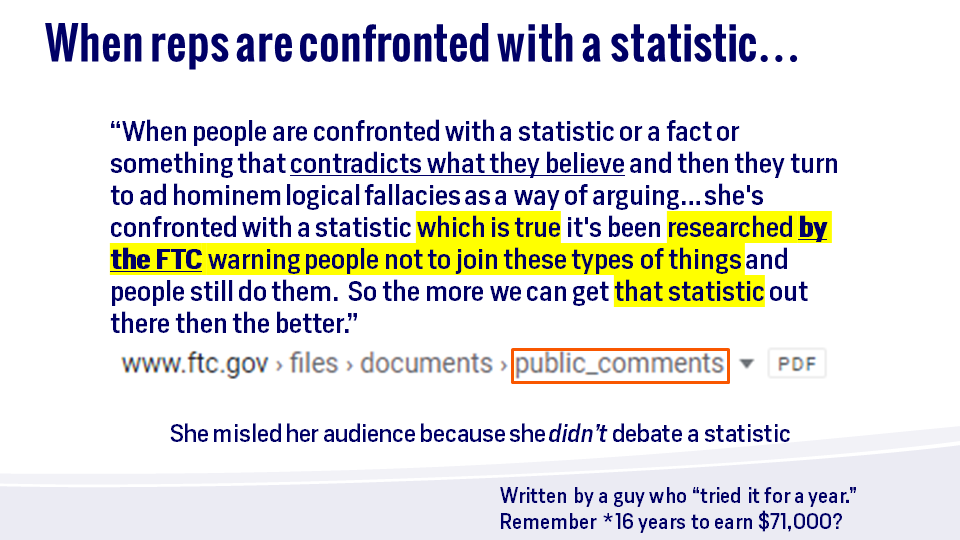
The “90% fail” statistics was not studied by the FTC.
What a major mistake she made.
She’s saying that the FTC is warning people not to join these things and is calling on her audience to get the word out, get this statistic out to more people. In other words, get the lie from a public document, not an FTC document, out to more people without a comparison. Kylie misled her audience because she didn’t debate a statistic.
Anti-MLM’s Bite Comes from Omitting a Comparison
In conclusion, nearly all of the anti-MLM content mentions how few people succeed. Its bite comes because John Taylor omitted a comparison, Kylie omitted, a comparison, and any other person who is out there promoting “few people make money,” omit a comparison.
I saw a video where they were comparing Network Marketing to McDonald’s. “If you worked at McDonald’s, you would make more money.” That’s not even one of those things that you can compare it to, because we want to be entrepreneurs.
Don’t make fun of us because we’re trying to step out of the W2 income and go into the 1099 income, which is how the wealthy get wealthy.
Quite honestly, I was very shocked when I looked at the numbers in the above comparisons, so I’m going to do a full upcoming video to cover that. Don’t think that everything I’ve said here is all I have to say about it, so be watching for its release.
Any social media person who has posted that few succeed, did not look with a curious mind. They’ve done a disservice to their audience.
What gets promoted becomes public opinion, regardless if it’s true or false.
YouTube uses the like button, the share button and comment section to determine truth.
It’s a strange world we’re in. When people do not know how to evaluate, they listen to opinions. A lot of times when people use a lot of emotion, their listeners feel that what they said is true.
That isn’t necessarily the case. So, truth is now in your hands.
Drop me a comment and let me know what you think about this – I look forward to your replies.
P.S. If you don’t have a team, haven’t recruited anyone (or less than 10 people), this is THE course you should get – Network Marketing Training Course