Network Marketing vs. Amazon – Which is the Better Side Hustle?
In this video, we are talking about network marketing income compared to Amazon sellers. If you’ve watched the other videos in this series (Network Marketing vs. Real Estate or Network Marketing vs YouTubers vs Actors), you know we’ve uncovered some interesting numbers.
But, the shock factor with Amazon sellers comes from a different direction than the other comparisons we’ve made.
Between November 14 and December 10, 2019, a company called Jungle Scout surveyed 1,046 experienced Amazon sellers who have more than a year of selling experience and at least one live product listing.
Respondents represent 93 countries, all 14 Amazon marketplaces, and all relevant Amazon product categories. They are ages from 18 to 80+, as well as all genders and levels of education. So I’d say we have a pretty good sampling of the data.
This stuff never ceases to amaze me. Numbers are numbers, and when you line them up side-by-side, it’s so gratifying to see how our industry compares. Let’s see who’s got the better side hustle, shall we?
What Kind of Business Do You Want to Be In?
A good question to ask yourself before going into any business would be, “What kind of business do I want to be in?”
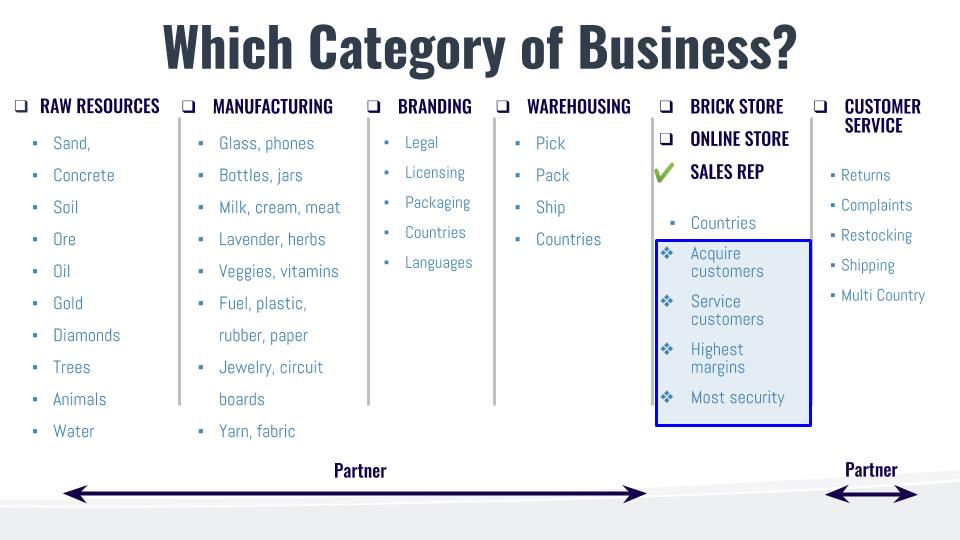
A few weeks ago I released a video called What is Network Marketing, and in this video I discussed the different categories of all product-based businesses.
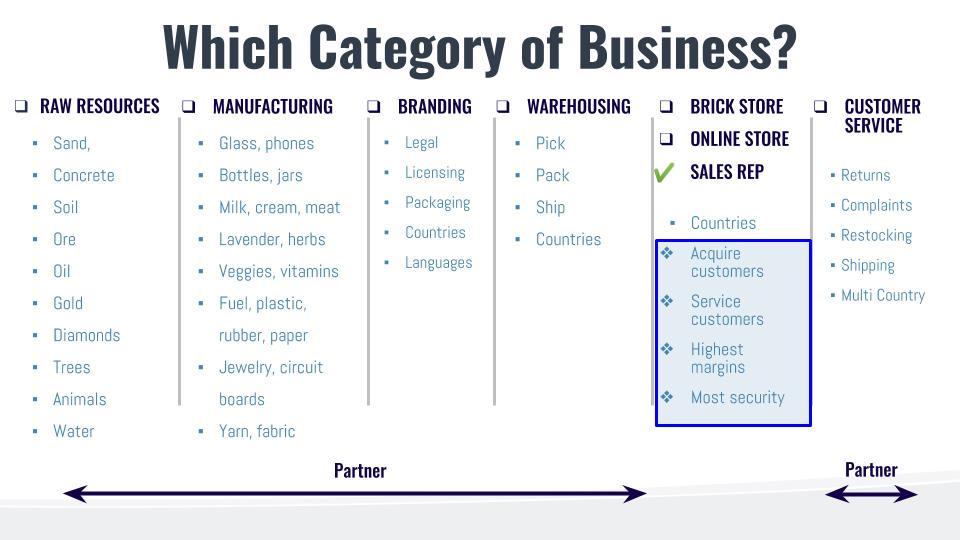
If you’re wondering what type of business you want to have, or what type of product you would sell, you might choose from any one of these categories:
Raw Resources – items you can extract from the earth such as sand, concrete, soil, ore, gold, diamonds, trees, animals and water.
Manufacturing – this industry uses raw resources and creates products out of them, such as: glass, phones, bottles, milk, meat, lavender, vitamins, fuel, plastics, jewelry, circuit boards, fabrics
Branding – this industry includes products like packaging, legal services, licensing, business set up in other countries or languages.
Warehousing – includes services such as order fulfillment and packaging, shipping services and delivery, export and import to other countries.
Sales – within this category there’s brickstores (physical stores), online stores and being a sales rep.
Customer Service – in this industry services include product returns, handling complaints, restocking inventory, and shipping services.
For me personally, I’ve found the sweet spot working in the Sales category, specifically as a Sales Rep. As a sales rep in Network Marketing, I acquire the customer, and service my customers. This is where the highest margins are and the most security.
I partner with a company that handles everything else from raw resources to manufacturing to branding and warehousing and even customer service. The company I partner with handles all of that – and I just get to focus on this area highlighted in blue.
Now, let’s look at the categories from the Amazon model. Everything in the orange highlight is Amazon’s job. The blue highlighted area is what the Amazon seller does.
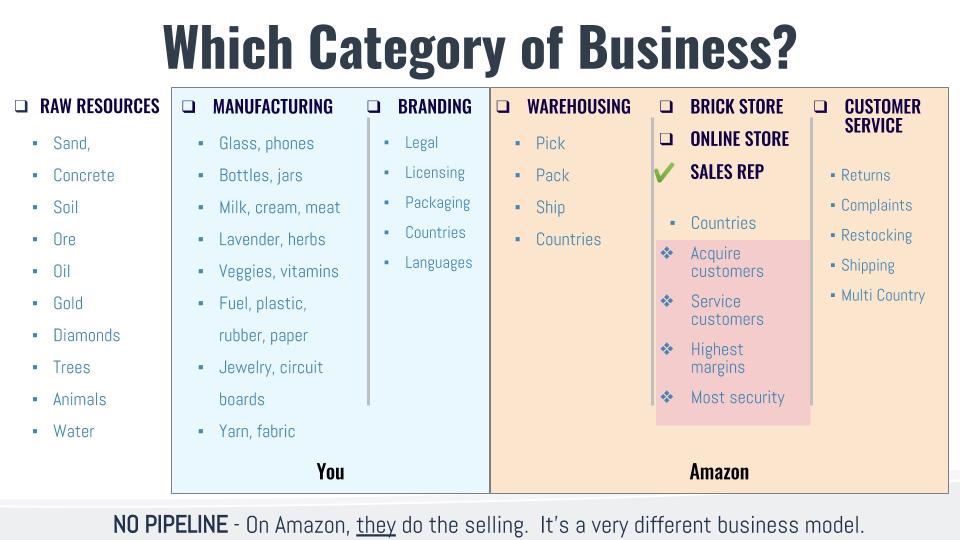
The Amazon seller has to create a product – develop it and do the branding and licensing of it. The Amazon seller gets to create the packaging for it and come up with the images and sales copy and come up with everything that is needed to sell the product in the Amazon store.
Then, Amazon comes in and does the pick, pack and shipping. Amazon also owns the customer (meaning, Amazon collects the customer information. As the seller, you don’t get the customer info so you can market to them in the future or generate repeat sales.) Amazon will also handle all of the customer complaints and returns.
Business Revenue – Amazon Sellers vs Network Marketing
Another factor to consider when trying to decide what type of business you could do, would be the amount of money you can make. So let’s examine that.
Here’s a breakdown of the numbers:
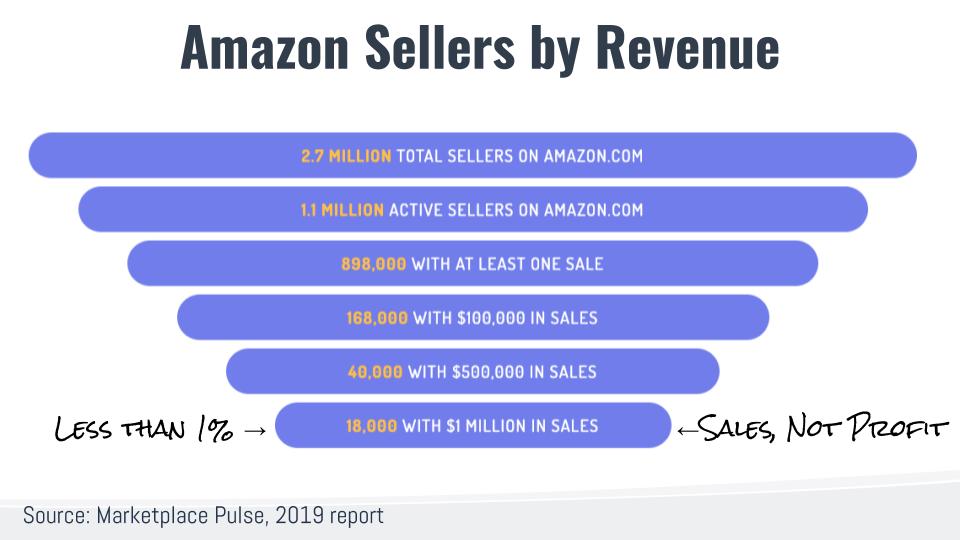
In 2019 there were 2.7 million Amazon sellers. Of that group, 1.1 million were active sellers on the Amazon platform, and 898,000 had at least one sale. 168,000 sellers made $100,000 in sales and then 40,000 sellers had $500,000 in sales and 18,000 sellers had 1 million in sales. (Note: these numbers are sales, not profits and all of this data was extracted from Market Place Pulse.)
The average profit an Amazon seller makes is 17.5%. So for the 18,000 sellers who have 1 million in sales, they are going to profit $175,000. That’s less than 1% of all Amazon sellers do 1 million in sales. (not profit)
What to Sell on Amazon
As an Amazon seller, of course, you have to decide what you are going to sell. You can private label an already-existing product or you can create your own product brand and label.
If you want to private label something, that means somebody else has already created the formula or product, and all you’re doing is just private labeling that product. It’s basically the same product that someone else is selling, but under a different name or brand.
Another option is to buy wholesale, which is buying products directly from a brand or distributor, and then marking it up and sell on Amazon. Note in this example, you do not have a unique product, because others are also selling the same product.
Another type of product you can sell would be creating handmade crafts or products.
Compare this to Network Marketing – the company I chose to partner with does all of the product research and development. The company finds unique products and typically, they are products that are high quality too.
Because the company does all of the development and research and covers the costs to develop and manufacture, I basically have products available at my fingertips that I can retail. I don’t have to do all of the work (and pay for the costs) of product development and research like the Amazon reseller.
Start Up Costs
Just as in any business, you can expect there to be start up costs associated with getting your Amazon business up and running.
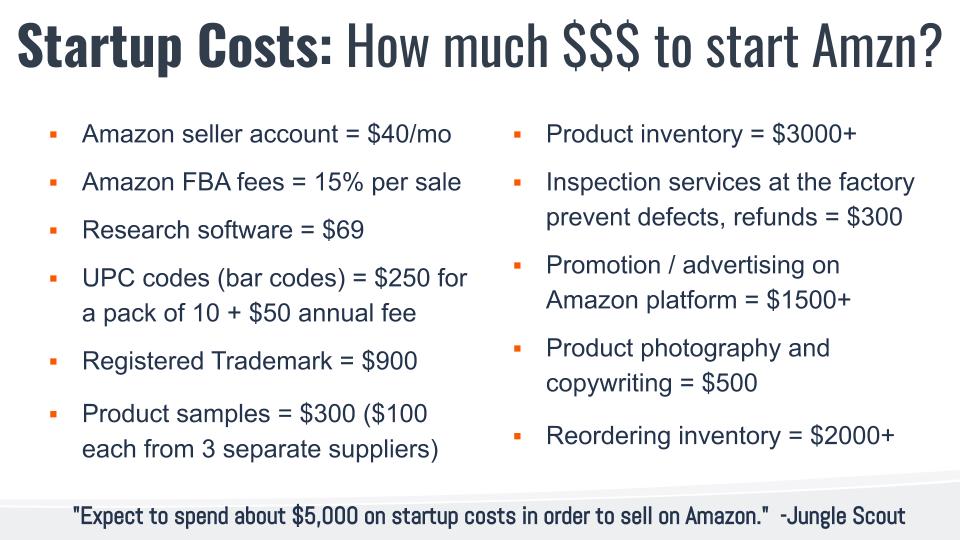
Amazon start up costs include:
- Amazon seller account – $40/month
- Fulfillment by Amazon fee – 15% per sale
- UPC codes – $250 for a 10-pack + $50 annual fee
- Registered trademark – $900
- Product samples – $300
- Product Inventory – $3,000+
- Inspection services to prevent defects and refunds – $300
- Promotion and advertising on Amazon platform – $1,500+
- Product photography and copy writing – $500
- Reordering inventory – $2000+
According to Jungle Scout, an Amazon Reseller should expect to spend about $5,000 on startup costs in order to sell on Amazon.
Look Deeper to Get the Full Picture
So, keeping all of this in mind, let’s look at the Amazon Seller data – and to do this, we need to look at how we acquired these numbers.
We start out with 710,000 Amazon sellers. And the reason we start with 710,000 is because in an earlier video of a side-by-side comparison, we learned that 710,000 real estate agents start on the journey to become a real estate agent.
So to look at the data and compare various industries side-by-side we have to start with the same number.
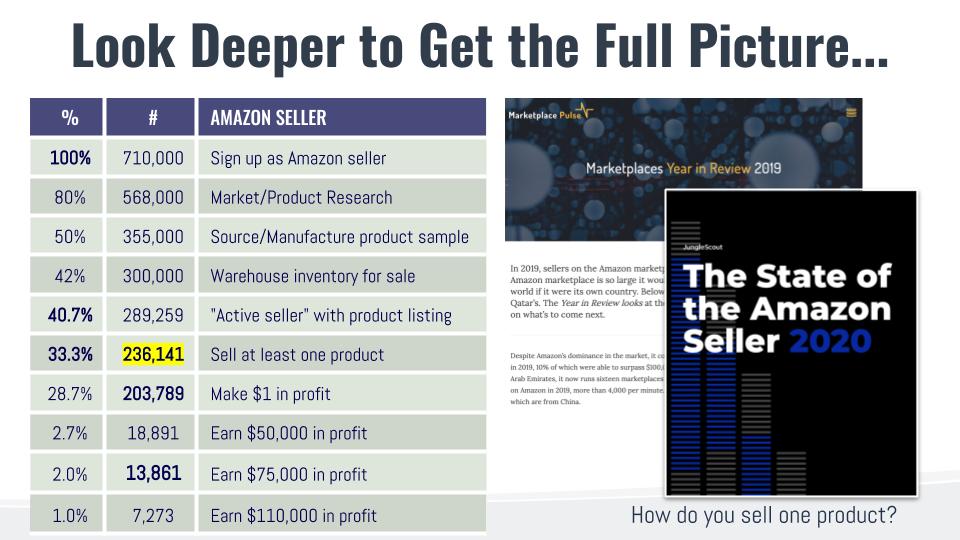
With that in mind, we start out with 710,000 people who sign up as an Amazon seller. Of those 710,000 who sign up, the numbers fall like this:
568,000 complete the market and product research phase
355,000 source manufacturing a product and get product samples
300,000 warehouse inventory for sale
289,259 become active sellers with a product listing
236,141 sell at least one product
203,789 make at least $1 in profit
18,891 will earn at least $50,000 in profit
13,861 will earn at least $75,000 in profit
7,273 will earn at least $110,000 in profit
Amazon Sellers Compared to Network Marketing
Now that you have the Amazon seller numbers, let’s see how they compare to Network Marketing.
Let’s zero in and start the comparison with how many people sell at least one product.
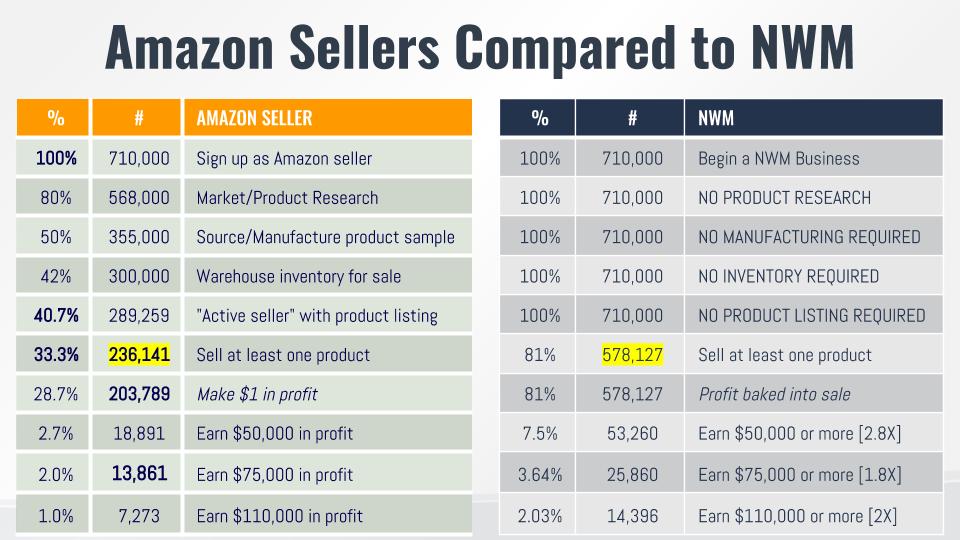
236,141 Amazon sellers sell at least 1 product. 578,127 Network Marketers sell at least one product.
203,789 Amazon sellers made at least $1 in profit. In Network Marketing, 578,127 sold at least 1 product, and the profit is “baked” into the sale.
18,891 Amazon sellers will earn $50,000. In Network Marketing, 53,260 will earn $50,000. That means 2.8 times more people in Network Marketing will earn $50K compared to Amazon sellers.
13,861 Amazon sellers will earn $75,000, compared to 25,860 Network Marketers who will earn $75,000. (That’s 1.8 times more)
7,273 Amazon sellers will earn $110,000 compared to 14,396 or 2% of Network Marketers will earn $110,000.
The shock factor comes in the data that I’m about to share with you, but just looking at it on a side-by-side comparison, there’s a couple of things that immediately come into my mind, which is that in Network Marketing, we’re doing something called the Pipeline.
In Network Marketing we are the ones generating the customers and we own the customers. We can also find and train other representatives by running ads or generating leads, contacting them, setting appointments and then training those reps to do what we do.
And you say, “Well, why in the world would you train your competitor?” Well, because they have the same compensation plan that I do, right? And so therefore I can earn a little bit of a percentage off of their efforts.
In my 32 years of Network Marketing experience, I’ve had a six to seven figure income. And the reason being is because, undoubtedly, as an organization builds, you’re going to find people who are better than you. And that’s what you want on your team.
You get an exponential, residual income.
It’s not just a residual income on one product, but you teach your reps how to market products. And you really benefit from this model when the company rolls out new products. If you’ve taught your team how to market and how to sell, then they become very good at selling the new products the company releases.
That is one of the fundamental differences between being an Amazon seller and Network Marketer.
The Good: Why Choose Amazon?
One of the sources we used to gather the Amazon seller data also published this list of reasons to be an Amazon seller.
- Be self-employed – replace current job
- Flexible work hours
- Live, work and travel anywhere in the world
- Explore a new business opportunity
- Business expansion in a new sales channel
- Additional income
- Good side hustle to make extra money
- Higher profit margins on average compared to other types of small businesses
These are all really good reasons to have your own business. But now let’s look at a few reasons why not to choose Amazon.
The Bad: Why Not to Choose Amazon
Number one: You don’t own the customer. That’s the biggest one. You don’t own the customer – Amazon owns it.
Number two: No residual income. Sell once, get paid once. That’s it.
Number three: The Seller Has A Lot of Responsibilities – Amazon is the biggest marketplace and there are some advantages for having your product listed where a lot of people shop but the flip side of that is that you still have to worry about product sourcing and manufacturing, and you need expertise in sourcing unique and different products.
You have inventory to purchase, maintain and warehouse. Then there’s all of the fees, and because you’re in a marketplace with a lot of competitors, there’s very little to distinguish your product from other sellers.
And I might add that many sellers are becoming extremely sophisticated. There are sellers who have really mastered this trade and they develop sophisticated systems in order to dominate the Amazon market.
Number four: At the Mercy of Amazon – Another consideration would be the fact that Amazon sells its own products that directly compete with their sellers.
They often undercut their sellers with their own products. I see it happening at Whole Foods. A while back I noticed a product at Whole Foods called Bark Thins.
There was a whole shelf of different brands of chocolate products. But on display in front of the whole chocolate shelving was the specific brand made by Amazon.
That was interesting to me because I thought, “Man, they’re undercutting Bark Thins.” There was a tremendous amount of demand for the Bark Thins product, and so what did Amazon do?
They created their own version of Bark Thins, and then made it less expensive.
The point I’m trying to make here is that as an Amazon seller, you get to sell “in the beast”, but then the beast has the capability of knocking you out of the way.
To me, that was the big shock factor. You’re at the mercy of Amazon.
- 76% of sellers are concerned about Amazon shutting down their account, without reason!
- 46% of sellers are concerned about Amazon protecting their privacy and security, as well as mining their database, and knowing their entire business model. Amazon can see how much money they’re making, and exactly what they’re doing. Their entire business model is exposed to competition.
- 68% of sellers are concerned about Chinese suppliers selling their products, or something similar at a lower cost. You can see this with Nike. Nike sends their products over to be manufactured in China. Well, all they did was train them how to create Nike shoes, right? And so now China can turn around and manufacture that same design under a different identity.
- 57% of Amazon sellers are concerned about the impact of tariffs on goods and services from China.
- 47% of sellers are concerned about the rising costs of goods. In the survey, sellers stated that they had to pay more for their products due to the higher tariffs.
Which Category of Business Do You Want to Be In?
As with any business, there are pros and cons. To be fair, there is probably a list of why someone should not do Network Marketing. But when I balance it all out, the advantages to Network Marketing are superior.
As a Network Marketer, all I have to do is focus on this little “blue” category here:
When I think about the effort of going through all of these other activities to come up with a product, especially being in a part time business scenario, I want my business to be able to go all the way up to high wealth, residual income.
That’s the reason I feel so strongly about the benefit of being able to acquire the customer and service the customer.
The Pipeline: How to Increase Your Income
Another benefit of the Network Marketing business model is that you have more control over your income. Here’s an example.
As an Amazon seller, there are some factors you do not have any control over that can affect the amount of income you make.
Let’s say you have a product that ranks very high on Amazon. You pay a lot of money in advertising and so your product ranks higher. That means more people will see your product listing.
But another seller can come in with a competing product and they’re willing to spend a lot of money and as a result, their product ranks higher and your product gets a lower ranking.
Now, your product isn’t getting as many eyeballs on it as it previously was.
Fewer people seeing your product means fewer sales.
In Network Marketing, if I want to increase my income, I just do more of the “Pipeline.”
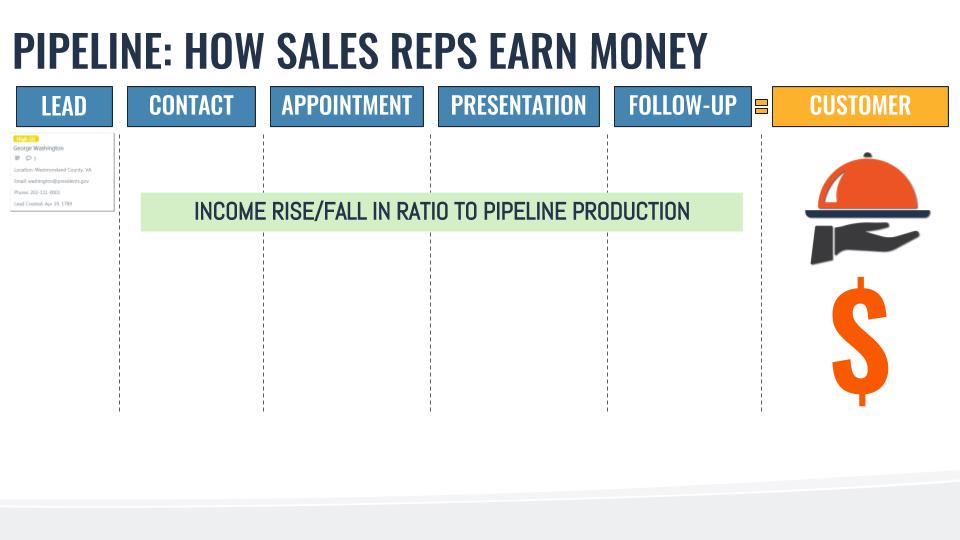
Online, you show an ad that goes straight to the presentation. The lead becomes a customer, you service them, and you make money, that’s it.
If you want to recruit another sales rep, then you want to train them on what you do. You generate a lead to see a presentation, the lead completes an application, then you meet and do a zoom call with them. And then they become a rep. You service them by training them, and you earn a small percentage of income for training them.
In Network Marketing, your income will rise and fall in ratio to your Pipeline production. It is the quantity across the categories. That is the real way to master the game.
Also, recognize that each one of these columns is a skill to develop. So the better I communicate with my messaging on my ad, the better I will connect with the lead.
If I contact that person and set an appointment and do the presentation, each one of these columns requires a skill level, but it’s always going to be quantity while increasing skill level is how you end up earning residual income.
And I would add that the better you train your people, the more long term residual you’re going to have.
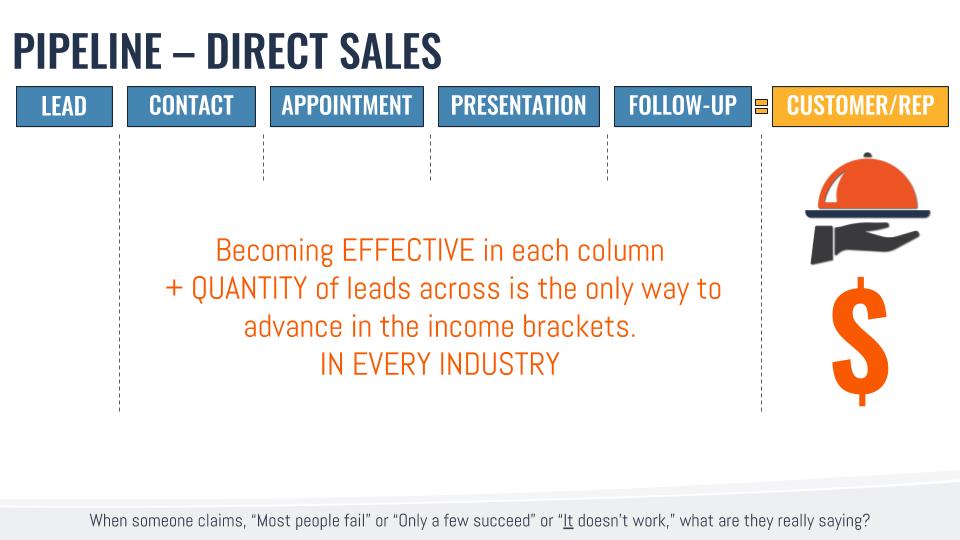
In summary, in Network Marketing, I have the highest margins, most security, and I own the customer. That’s the reason I prefer this industry.
Now it’s your turn. Please comment below and let me know what you think about being an Amazon seller. Have you tried it before and what was your experience? I’d love to hear your thoughts on this and how it stacks up compared to Network Marketing.
P.S. If you don’t have a team, haven’t recruited anyone (or less than 10 people), this is THE course you should get – Network Marketing Training Course