Network Marketing vs Traditional Sales (Are You Sure You Want a Salary?)

Today we are talking about Network Marketing compared to Traditional Sales and, I’m on a mission. (I hope you’ll join me in this.)
I’m on a mission to get the word out that being a network marketing rep is almost no different than being a traditional sales rep. They’re identical. Think about this:
Both have to do the Pipeline.
Both are paid on production.
More quantity of leads across the pipeline = more money. Simple as that.
But there’s one distinct difference, and it’s whether you require a salary up front or not.
A salary sounds stable and comforting, but are you sure that’s what you want? Today we’re taking a look at network marketing vs traditional sales, and which one earns you more money.
The Sequence All Sales Reps Go Through to Get a Sale
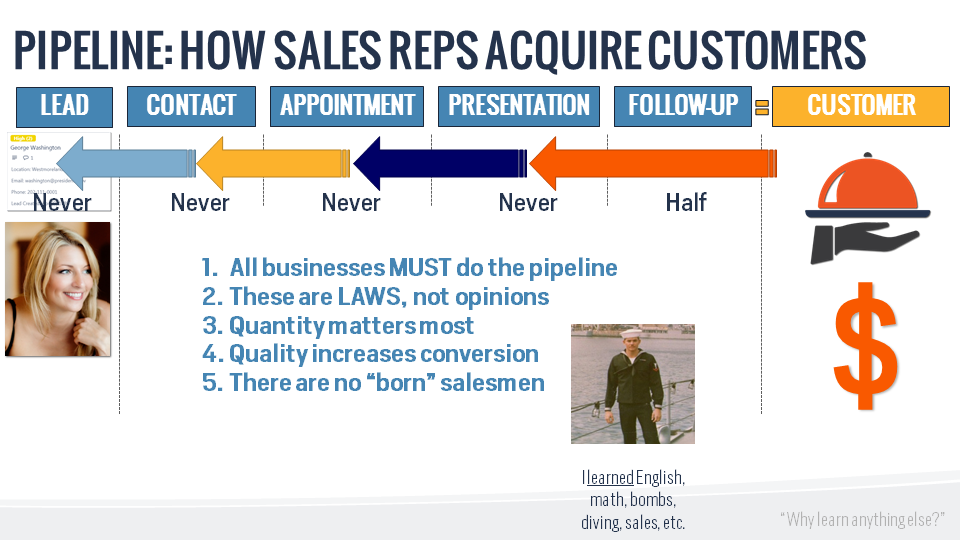
The first point to understand is that all sales reps go through the same process. It may be a different product, but they’re all going to be doing the same thing. It has to do with this concept that I figured out. See, my background is bomb squad and we tend to see things in sequences.
Here’s the sequence: I knew that for every customer I got, I had to do a presentation before I got that customer. About half of the time, they would say yes at the presentation, and the other half that were going to buy my product would require a follow-up of some kind: “I don’t have my credit card on me.” “I don’t have my checkbook,” etc.
I’ve never done a presentation where I didn’t set an appointment before the presentation. Not all companies require that, but certainly high-end restaurants would do that. Attorneys would do that. Doctors would do that. You have to set an appointment.
And I’ve never set an appointment where I didn’t contact the person first, and I’ve never contacted somebody where I didn’t generate a lead first.
This sequence is what I call the Pipeline, you can get more training on it here.
That’s why this is a law. It’s not an opinion. All sales reps must do this. It’s called the Pipeline.
The Traditional Sales Rep
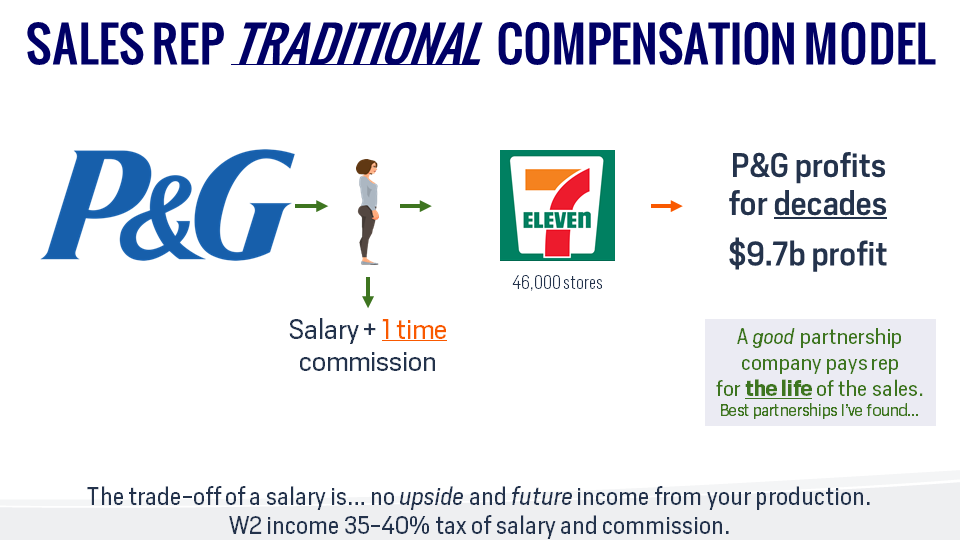
Take as an example, Procter & Gamble. The sales rep is going to go out and try to get Procter & Gamble’s toothpaste and toothbrushes into 7-11 stores. Let’s say that she does, and she gets all 46,000 stores. She’s going to get a salary plus a one-time commission. I don’t know if she gets more if she gets them in more stores, but the concept that I’m really trying to get across to you is that it is a salary plus a one-time commission.
The Two Bad Things that Happen When Salary Is Part of Your Compensation
When a salary is part of the compensation, two bad things happen. The first one is that you’re going to lose 40% of whatever that salary is, because it’s W-2 income. Whatever commission you get, you’re going to get a 30-40% cut in that commission because it’s W-2 income.
The next thing is that Procter & Gamble is going to profit from this for decades. That’s how they were able to make $9 billion of profit last year. But this sales rep, she doesn’t get that upside potential the next year and the next year and the next year and the next year. She gets the salary plus one-time commission while the company profits year after year for the work she did to acquire that customer.
The biggest cost is acquiring the customer. The most amount of effort that is involved in this process is acquiring the customer. To forfeit that upside potential because you want a salary is, from my side of the equation, not a good deal. I don’t like that deal.
That’s the way that I see it, because it’s a trade-off of network marketing to say, “I’m going to take a salary plus commission.” Network marketing pays commission-only, and gives the upside residual income on the customers acquired.
Why Would Someone Want a Salary?
The only logical reason that I’ve ever seen why a person would have to have a salary is if they don’t know this Pipeline game really well.
This is the only game that you play in the sales arena: you’re just moving leads across the Pipeline, and you’re looking for people who want what you have.
You’re not looking to convince people to buy what you have. You’re looking for people who want what you have. You’re just not doing enough quantity or not doing enough quality with moving leads across the Pipeline if you feel you need a salary.
You’re not looking to convince people to buy what you have. You’re looking for people who want what you have.
I’ve been on the other side where I’m looking at somebody’s resume and they’re telling me what an incredible sales person they are. Then I say, “If you do a salary plus commission, then I’m going to pay you half of what you could make if you did straight commission, because it’s better for my estimations.”
And he says, “No, I’m going to need a base.” “Why?” “Well, my wife wants to make sure that there’s always a steady paycheck coming in.” “Oh, your wife?”
What is he really saying? He’s saying, “I’m not sure I’m going to do this in enough quantity or quality.” Who’s going to cover that loss of income when he doesn’t do that? Me, the owner.
I think it’s far better to just really get great at doing the Pipeline. That way you get the upside potential and residual in a lot of cases.
A good partnership company pays the rep for the life of the sales.
In another earlier video I discussed “What Network Marketing Is.” It’s just basically a partnership where you acquire the customers, and they’re your customers, and the company gives you the upside potential.
The company shares the profits with the people who worked to get them there.
I’d Like to Know What You Think
What you think about this on a comparison between traditional sales reps and network marketing? Is there something else that I’m missing?
I haven’t been inside of a corporation where I got a salary plus a commission. I’ve always been commission only. Maybe you can share with me your experience in it.
Also step back and evaluate this from the viewpoint that I just showed you – I’d like to know what you think about that. Comment down below and let me know your thoughts.
P.S. If you don’t have a team, haven’t recruited anyone (or less than 10 people), this is THE course you should get – Network Marketing Training Course