Network Marketing vs Solopreneurs (The Rise of the Independents)
The workplace is changing. Even before covid, a staggering number of people were leaving the traditional workforce.
In the U.S. there are about 41 million people who work as “independents” — consultants, freelancers, contractors, solopreneurs, temporary, or on-call workers… people who work independently.
The vast majority of these are Solopreneurs — meaning they work and run their business alone.
These folks value their independence over anything else. It sounds nice, but is it really the best option to choose? There’s an unfortunate downside that many don’t realize until it’s too late.
So today, I’m excited to compare solopreneurs vs a network marketing sales rep.
My Top Solopreneur Gigs
A professor once told me, “Own it or sell it is the way to make money.” Throughout my life I’ve tried a number of different things to make money. I mowed lawns as a kid, and later tried a lawn-mowing business.
After making millions in business, I wanted to be a consultant, as I felt that would be best. But now that I’ve arrived at this place with many years experience in solopreneurship, I’ve learned some things and figured out better ways of earning money.
List of Solopreneur Jobs and Services (2:13)
There are hundreds of solopreneur type jobs but here are a few examples:
- Virtual assistant
- Social media manager
- Bloggers
- Writers
- Graphic and web design
- Photographers
- Bookkeepers
- Tax accountants
- Babysitters
- Handyman
- Translators
- Personal trainers
- Yoga instructors
In other words, it’s somebody who says, “I don’t want to have a job instead. I want to step out on my own and be independent.”
The Rise of Independent Workers (2:43)
The trend for independent workers has been on a rise for quite a while.
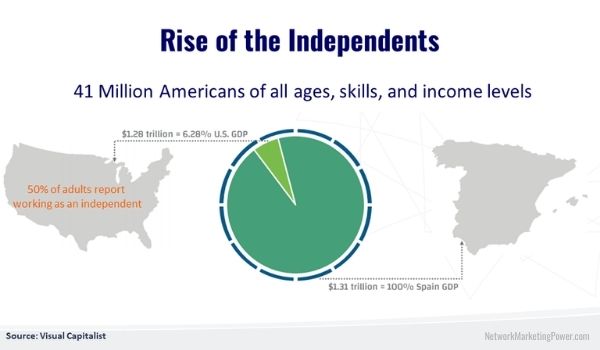
Forty-one million Americans of all ages, skills and income levels have entered into solo partnership or independence.
Fifty percent of adults in the working space have said they have worked as an independent in some fashion.
Why Be Independent? (3:12)
So what is so compelling about being an independent solopreneur? Here are some reasons:
- Stagnant wages in the job market – after inflation, real wages have barely budged for decades.
- Middle-wage jobs are hollowing out.
- People are seeking greater financial security – a person may feel that if they go out on their own they will have more security that way.
- For some it’s greater satisfaction – they chose to pursue a passion business on the side. In other words, they are doing something they love and have a lot of interest in.
- Some people want more control over when and where (and with whom) they work.
- Having the ability and flexibility to set your own hours
- Spending more time with kids and family
- Travel – digital nomads and having the technology available to travel and work anywhere in the world
- Build new skills
Occasional Independents and Side Hustles to Make More Money (4:14)
The Occasional Independent is a part-time independent worker who is in business because the work has become crucial to trying to make ends meet.
Many workers up and down the income ladder are finding that their compensation simply doesn’t keep up with the rising costs of education, health care and housing.
They also have a difficult time saving money for retirement or emergencies. In fact, a 2018 Federal Reserve survey revealed that 38% of Americans wouldn’t be able to pay an unexpected $400 expense with cash.
There are also many who are financially vulnerable – stuck in a “what would we do if” situation. For example – What if our car breaks down? What if the water heater goes out? What if I get sick or lose my job?
All of these reasons can cause people to worry about finances and so they go out and do a side hustle (job on the side) to bring in more money to make ends meet.
The Problem With Being a Solopreneur (5:51)
There are 28 million small business owners in America. 26 million of them have zero employees, and that means the business owner is doing it all.
For those who are willing to step up and be a solopreneur I say, Congratulations, you now own a job. But in some cases, it’s not easy to go solo as you might think.
In some cases you’re competing with cheap, outsourced labor. Let’s say you’re a graphic designer – now you’re competing with other designers out of other countries, or competitive marketplaces like Fiverr, who will do the work at a much cheaper cost.
You’re also trading your expertise for money, and starting over every day at zero. As a Solopreneur, you’re also completely dependent on your own output – you can’t take a day off or get sick because when you stop working, you aren’t getting paid.
Solopreneurs are also on their own for covering their own benefits – like insurance, 401k, marketing and advertising, etc.
All the Extra Work Solopreneurs Have To Do (8:25)
Stepping out and deciding to be a Solopreneur is commendable, but oftentimes they fail to properly estimate the amount of “extras” they do in order to keep the business going.
For example, let’s say a framer wants to go out on his own. What he doesn’t realize is that he also needs insurance, finances, retirement, and legal services to set up the entity, and license protection. If he’s going to hire others, he has to do the hiring, training, firing and hiring and training. He has to do the bookkeeping and tax estimates.
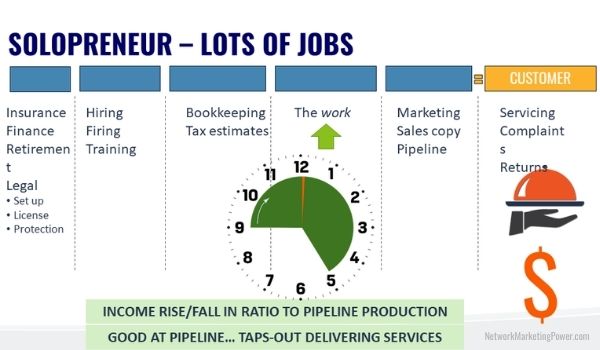
In the marketing department, he gets to write the sales copy, and do the other steps in the Pipeline. He gets to service the customers, deal with complaints and returns. You know, that door doesn’t quite shut a month after they leave and they’re still blaming it on the framer. You get where this is going?
There’s just a lot the Solopreneur has to do -more than just the framing work. He thought he would step out and just frame, but as you can see there’s so much more work to it.
J. Paul Getty, a petro/fuel billionaire said, “I’d rather have 1% of the effort of 100 men, than 100% of my own effort.”
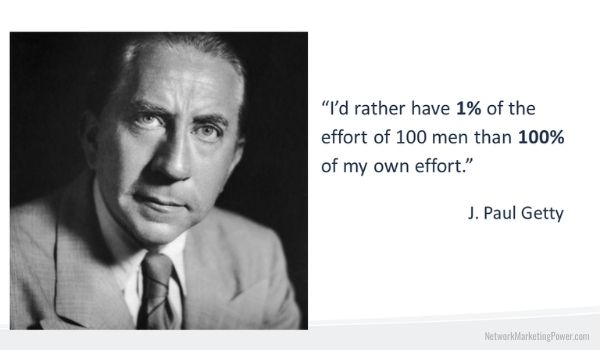
And what does that mean? In other words, if you want to be a solopreneur if you’re looking for wealth or time freedom, then you have to have a team around you in order to really make that happen.
Linear vs Residual Income – Robert Kiyosaki’s Cashflow Quadrant (10:30)
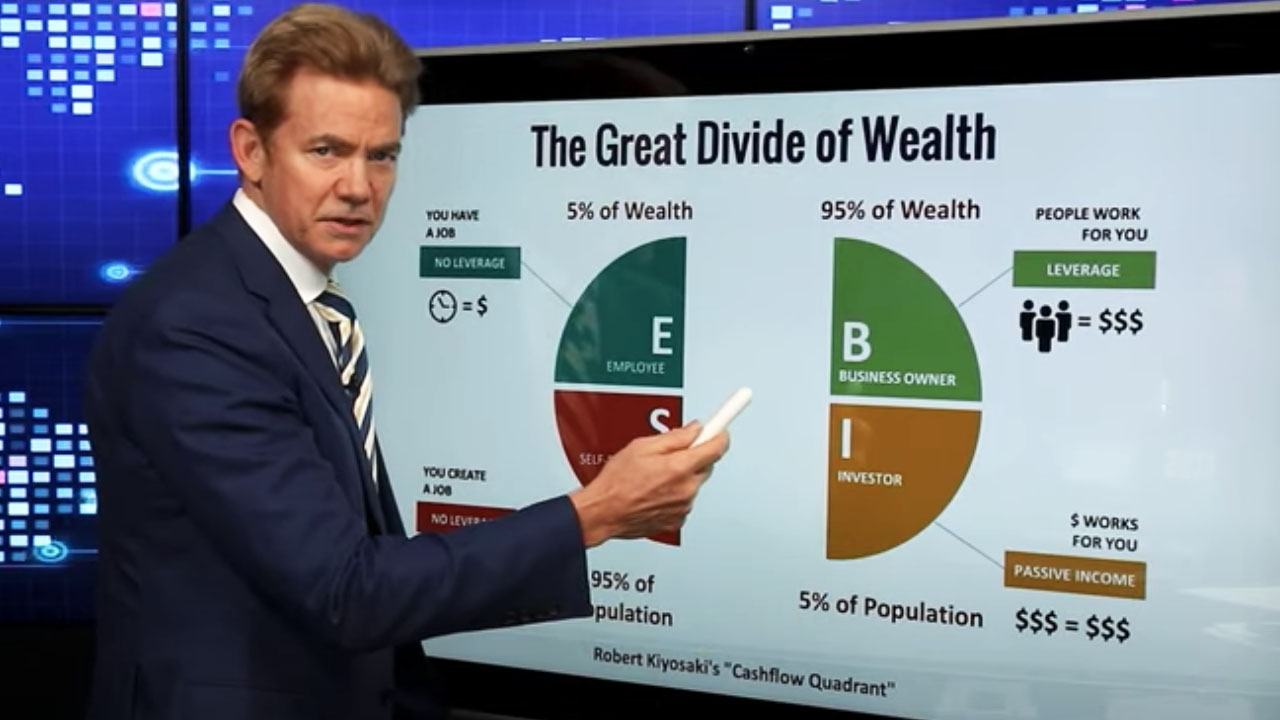
Robert Kiyosaki laid out something called the Cashflow Quadrant. Money is made in four areas, or brackets.
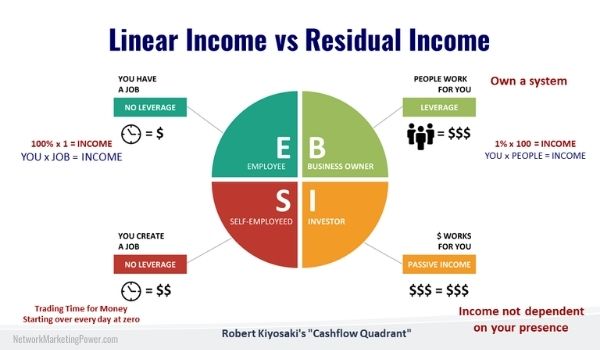
The first bracket is an Employee. 100% of yourself times one person equals your income. There is no leverage.
The second bracket is Self Employed. This is the Solopreneur right here. You create a job trading time for money and start over every day at zero.
The third bracket is Business Owner. The owner gets paid on his efforts times the effort of 100 others’ effort and that equals income.
The fourth bracket is Investor/Passive Income. This is where you have your money working for you. So that might be things like investments in real estate or the stock market, buying businesses, etc.
The Great Divide of Wealth (12:08)
Now let’s look at these quadrants from another perspective.
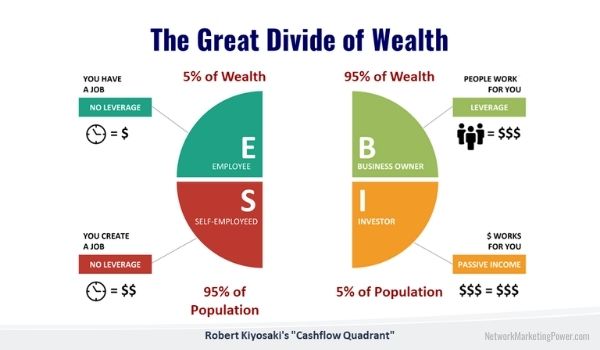
The reason I show this to you is because 5% of the wealth sits in these two categories – Employee and Self Employed. And 95% of all the wealth in the world sits in these two categories – Business Owner and Passive Income.
While only 5% of the wealth is in the Employee/Self Employed quadrants, 95% of the population is also in those two quadrants. Compare that to the other two quadrants – while Business Owner and Passive Income have 95% of the wealth, they contain 5% of the population.
The group of Employees/Self Employed get quite angry at the Business Owners/Passive Income people. It creates a divide of wealth and the employees and self employed people say it’s unfair that the other people have all of the money.
But – anybody can step over into the Business Owner/Passive Income category.
The Business Owners/Passive Income people stepped over into this category and they understand it.
The Employees/Self Employed people probably don’t quite understand this concept, or they have something that trips them up, like they are worried about what others might think. They may be afraid of going out on their own.
In my experience, the people who do step over to Business Owner/Passive Income deal with those same issues too, the difference is they figured out how to deal with it until they can get over it.
Product-Based Business vs Service-Based Business (13:18)
In another video I explained this, which is, what category of business do you want to be in?
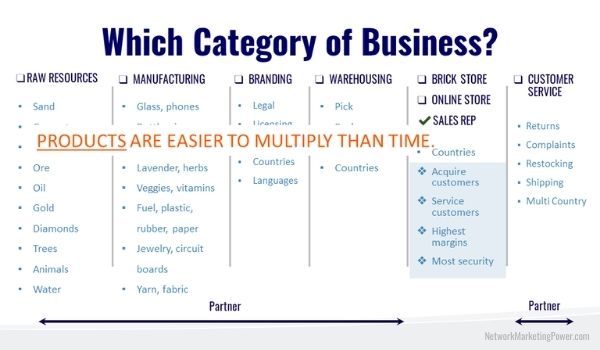
What it comes down to is this – number one: I want a product-based business. I don’t want it to be a service-based business because products are easier to multiply than time.
In other words, I could repair phones or I could sell phones. If I repair phones, I can’t multiply my time. But if I manufacture phones and then sell them, I can manufacture a million of these at a time. That’s the difference.
Remember, products are easier to multiply than time. Many solopreneurs are service-based, which is what limits you.
Who Has the Highest Margins and Most Job Security? (14:30)
What I look for in a business is I want to just focus on being able to acquire customers and serve them, because that’s where the highest margins are and it’s also where there’s the most security.
And why is it the most secure? Because whoever is closest to the customer has the most security. A lot of people think that the CEO is most important.
No, I say the customer acquisition team is the most important and they always will be. The company doesn’t get paid without that team bringing in the customers.
If you are interested in finance or you want to be in that 5% category of Business Owners/Passive Income, then I highly recommend it be moving a product of some kind.
Leverage: How to Multiply Your Time to Earn More Money (15:30)
The way that you actually multiply time is by doing the Pipeline.
You want to get customers and the way you get customers is you generate a lead. You set an appointment. You show them the thing you’re selling. You follow up with them – and you’re going to get a Yes or a No or a Maybe. So then you either follow up some more, or you get a customer, you serve them and you make money.
Once you get good at that, now it’s time to train another what you do. And that is how you multiply time.
The reason being is because if you get a sales rep and you train that sales rep exactly how you do it, then you earn a small percentage of what that person sells. Now you’re getting a hundred percent of your effort and let’s say 5% or 3% or whatever it is of another person’s effort. And then you keep doing that as many times as possible. In other words, you keep training other people.
The greatest advantage of this type of business model is that I want the people I’m training to have the same compensation plan that I have, because that’s the most fair system I’ve ever seen.
When you go into a job, typically the situation is that they’re going to pay you what you’re worth based upon your resume. I would prefer to leave that out of the equation. I don’t want that piece. What I want to do is focus on “dones.” How many customers do I acquire? That’s what I want my income based on, not on someone’s opinion of me
True leverage comes into play when I train sales reps, and I get two people (or more) doing the Pipeline at the same speed that I’m doing. Now I’m getting leverage.
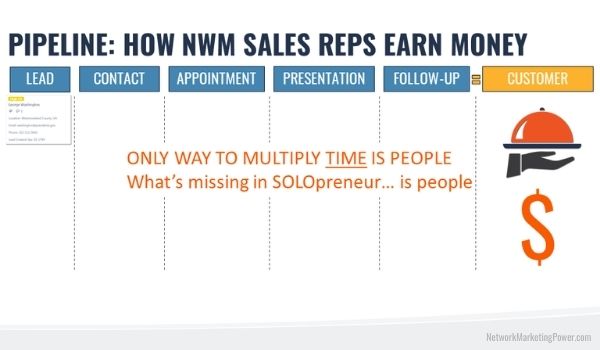
And that is what that whole quadrant is about, it’s all about getting leverage. So I keep doing it. And the best part is, there’s no end whether it be 10 people or 1,000 people or 5,000 people.
That’s the difference between Network Marketing and solopreneurship.
What do you think? Comment down below and let me know.
P.S. If you don’t have a team, haven’t recruited anyone (or less than 10 people), this is THE course you should get – Network Marketing Training Course