How Does Network Marketing Compare to a Regular Job?
Getting a job is the fastest way to income, no question. But is it the best way for you?
Today we’re going to look at how a “regular job” stacks up against a network marketing business. (Hint: there’s a lot more to think about than salary and benefits.)
I’m talking about freedom, the two tax systems in America, and something I call “the great divide of wealth.” (and when to switch from employee to business owner)
This video is great for anyone who wants to make more money and build a better future for themselves.
Advice for People Seeking a Job
The greatest part of having a job is that it is the fastest way to income. No question about it. You go and get a job. The employer agrees to pay you for doing certain activities, and at the end of the week you get paid.
That is the fastest way to money. But having a job is also what I like to call “frictionless”.
And what do I mean by that? Most of us have been indoctrinated that a job is the thing to do. No one is going to criticize you if you get a job.
Contrast that to another profession like a race car driver, a pro golfer or a network marketer – there’s friction there. Your friends and family are like, “You’re doing what!?” It’s unconventional. It’s not the “norm” of “go to school, get a job.”
If you’re worried about what other people think, then my suggestion to you is get a job and live on 48% of your income, and save 30%.
At one point in my life, I worried about what other people would think about me, so I went out and got a job. I didn’t want people to look down on me.
But then I had this little thought.
“They’re not going to pay for my house.”
“They’re not going to pay for my kid’s college.”
“They’re not going to buy my car.”
I realized that I needed to do whatever was going to get me what I wanted. So it really didn’t matter what my friends or family thought about what I was doing to make money.
We’re a society that has been taught the more education you have, the more you can request for a salary.
Whereas, in Network Marketing it’s all about production. The more you produce, the more you get done, the more you make.
The Average American Has Less Than $1000 in Savings
What does average look like in America? This graph is very telling with some key data.

The red dotted line – If you look at where this red dotted line is – this is where the 96% of Americans are. They haven’t seen a pay raise in a long time. This red line represents their retirement account, and it sits at about $20,000. (And they have less than $1,000 in savings.)
This chart shows some very interesting data based on people who have graduated from college.
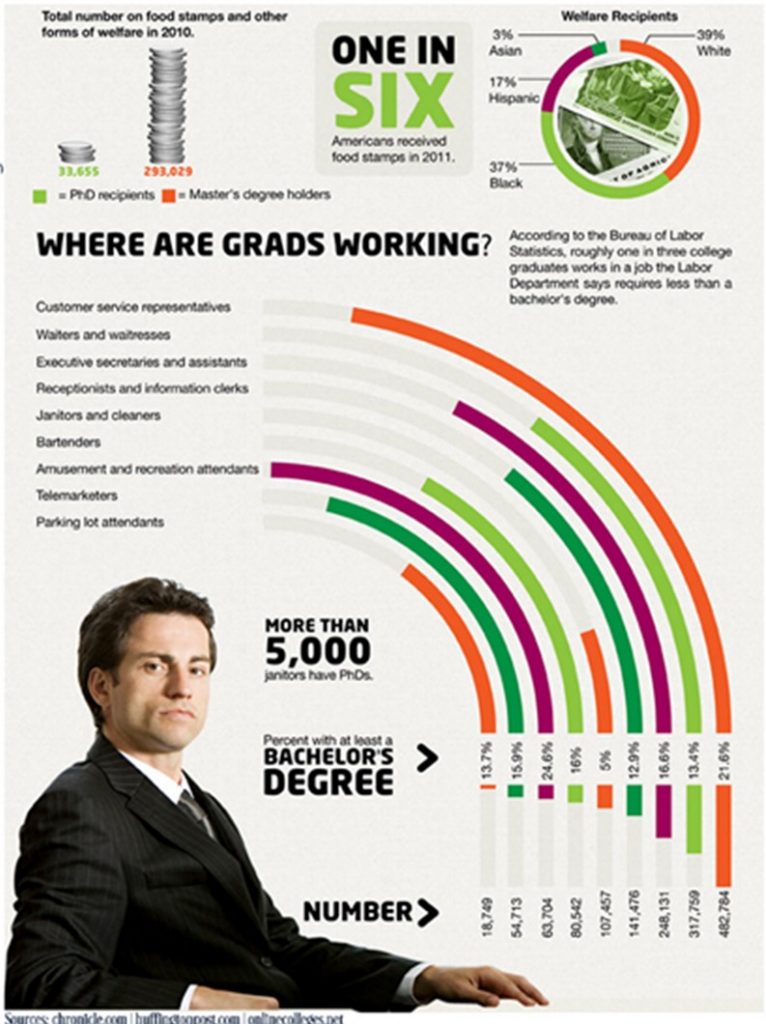
Did you know that 33,000 people who have PhDs are on food stamps, and 293,000 people with a Master’s Degree are on food stamps?
It costs the government (meaning our taxes) $65 Billion to cover those expenses. What the study finds is that people who have gone to school to get an education aren’t getting high-paying jobs with their degree and so now they are taking other jobs that don’t make as much and require food stamps to make ends meet.
I share this with you only to see that the idea or notion that if you just “go and get a great education” means you’ll get a great job and you’re set for life – well, oftentimes, that just doesn’t happen.
Inflation Kills Income Growth
The other key point that people with jobs don’t realize is how inflation can kill income growth.
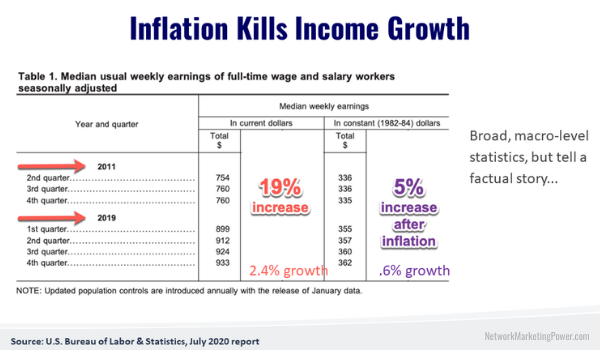
Check out this study – from 2011 to 2019, the study found that the average worker got a 19% pay increase – that’s 2.4% each year for 8 years. Not bad, right?
But in reality, it’s really just a 0.6% growth rate per year, for a total of 5% for eight years. And why the difference? Because of inflation. The rising costs of goods, of food, of utilities – all of those things we need to just live increase at a greater rate than your pay. So even though a 2.4% per year pay raise sounds really great – in reality the raise in income is really only 0.6% due to inflation.
The study also pointed out that the same inflation ratios were similar back in 1982 and 1984, so this is not a micro trend.
Two Tax Systems in America (W2 vs 1099)
The final point that really hits home is how expensive it is to have a job when it comes to income tax.
There are two tax systems in America: one of those tax systems is called the W2. It is for the poor people. The other tax system is the 1099 income or tax system for the wealthy.
It was set up for one primary reason. And that is, the 1099 people are the ones who typically create jobs. And what do jobs do? Jobs give people money and money gets put back into the economy in order to keep the economy growing. And because that 1099 person is taking risk and helping the economy grow, the government gives them a different tax schedule compared to a W2 person.
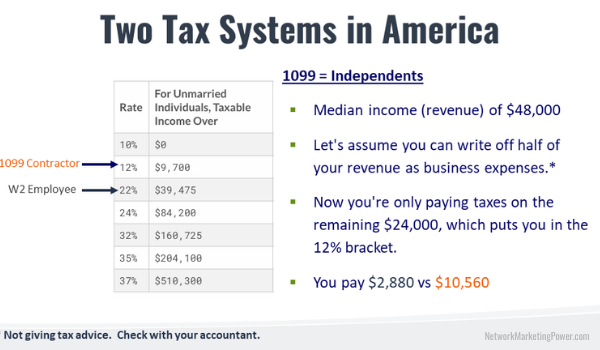
Here’s how it works. I want to show you how having 1099 income will help you to generate wealth.
Note: I’m not an accountant, I’m not YOUR accountant. So don’t take any of this as accountant advice; this is a theoretical conversation.
You own your own business. Let’s say you’re in Network Marketing and you make $48,000 a year. This would be 1099 income.
With 1099 income you can write off business expenses. Let’s say you write off the following expenses: travel, event admission, and marketing/lead generation. Those expenses totaled $24,000.
The business owner gets to deduct those expenses from the taxable amount, so now you’re only paying taxes on the remaining $24,000.
If half of that is written off, your taxable income puts you into the 12% tax bracket, so you would pay $2,880 in taxes.
Compare that to a W2 employee, whose income is taxed on the full amount of $48,000. The W2 employee would end up paying $10,560 in taxes.
$2,880 in taxes vs $10,560.
Can you see how that extra $7,680 is a way to build wealth?
Linear Income vs Residual Income
Robert Kiyosaki laid out something called the Cashflow Quadrant. I talked about this in another video episode Network Marketing vs Solopreneurs. It’s a very simple way to look at business options.
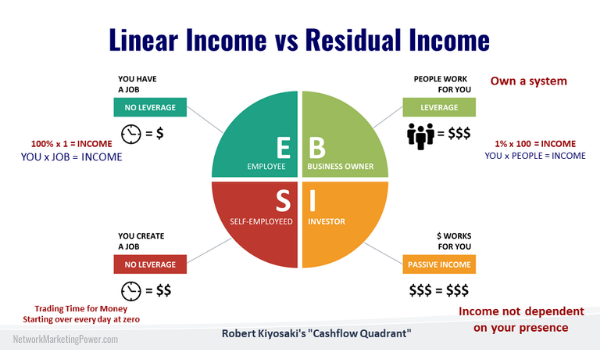
Money is made in four areas, or brackets.
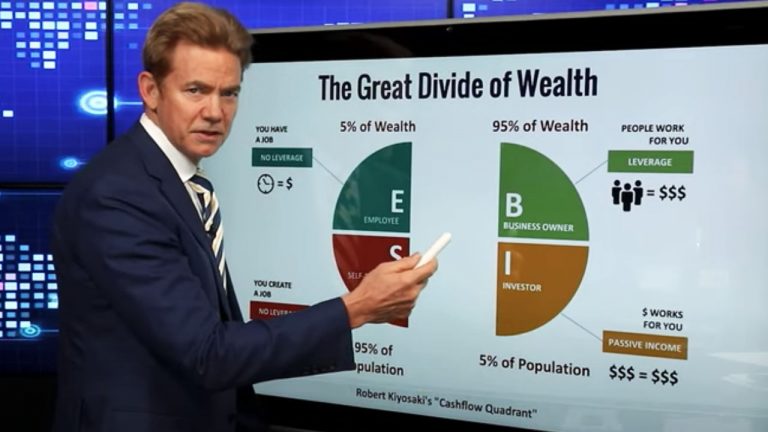
The first bracket is Employee. You are paid 100% on your own effort. Your effort times one (person) equals your income. There is no leverage. It’s all about the clock.
The second bracket is Self Employed. This is where you break off and you do it on your own.
The downside to this quadrant is that once you step out you realize, not only are you doing the actual work – let’s say it’s graphic design, but you also have to: get customers, do your own accounting, handle your own insurance, set aside taxes and all of the other responsibilities of a business owner.
You create a job trading your time and expertise for money – your expertise in being a lawyer, a chiropractor – you’re paying your expertise for money.
You’re also starting over every day at zero because if you aren’t trading expertise for money, then you aren’t getting paid.
The third bracket is Business Owner. The owner is leveraged by people. The business owner has other people doing the work that he/she gets paid on.
Let’s say I have a business and I work 8 hours a day, and then I have one employee who also works 8 hours a day. Now I’m being paid on 16 hours of work – even though I can only put in 8 hours.
What if I had 100 employees? You can see how you can multiply time by having others do some of the work. Being a business owner is the only way you can gain time.
The fourth bracket is Investor. This is where you have your money working for you. So that might be things like investments in real estate or the stock market, a car wash, laundromat, etc. Over time, these investments can also increase in value.
The Great Divide of Wealth
Now let’s look at these quadrants from another perspective.
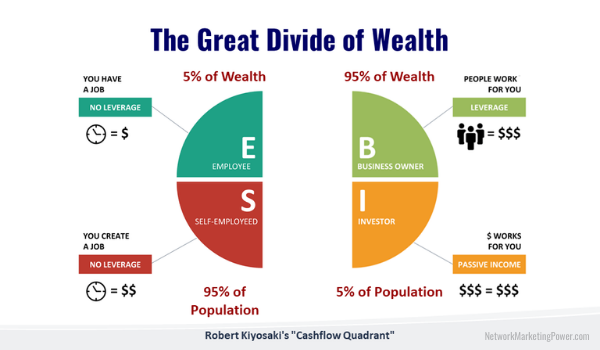
The reason I show this to you is because 5% of the wealth sits in these two categories – Employee and Self Employed. And 95% of all the wealth in the world sits in these two categories – Business Owner and Passive Income.
While only 5% of the wealth is in the Employee/Self Employed quadrants, 95% of the population is also in those two quadrants. Compare that to the other two quadrants – while Business Owner and Passive Income have 95% of the wealth, they contain 5% of the population.
The group of Employees/Self Employed get quite angry at the Business Owners/Passive Income people. It creates a divide of wealth and the employees and self employed people say it’s unfair that the other people have all of the money.
But – anybody can step over into the Business Owner/Passive Income category.
So You Want to Start a Business?
I think that Network Marketing is the easiest way to step over into the Business Owner/Investor side. And why is it easier? Well, here’s a list of things you would have to do if you were to go into any other type of business:
You have to have a business plan. Then, you need capital to get the business going. So, you present that business plan to a bank. That bank is going to loan you an average of $360,000. That’s the average loan at the Small Business Administration.
That’s a lot of debt and then you arrive at a sticking point. Do you do this business part time or full time? Well, you’d like to do it full time, but you can’t because you’ve got bills to pay.
And in Network Marketing, you’re not going to a bank and asking for money. You can start part time and build it. You’ve got a group of people who are willing to train you, and there are a lot of people within reach for you. If you want to see my top reasons for having a Network Marketing business, watch this video.
The main point I hope you’ve picked up in this whole conversation is that you’ve got to get over into the Business Owner/Investor category if you want to create wealth.
And if you stay in the Employee/Self Employed side, you need to put away at least 50% of your income into savings. People end up spending their money and then they don’t have anything saved up for retirement.
My Path to Wealth
The typical path to wealth looks something like this:
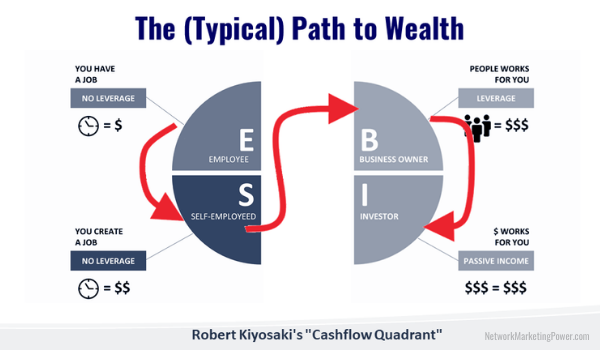
This is the track, if you will, that people typically go on. They go from an employee to owning their own business, doing the thing that they were doing as an employee, plus picking up a whole lot of other responsibilities.
And then they move over here into business ownership. They create money and then move to Investor. This has been my track for the last 59 years.
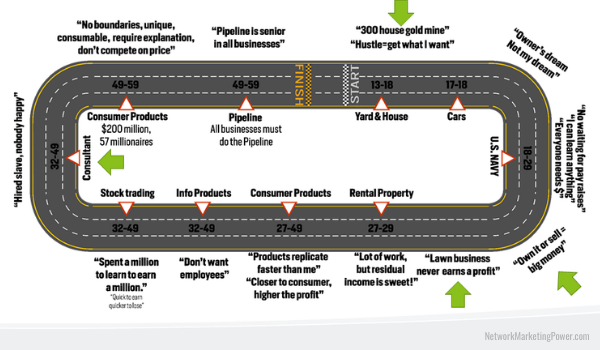
I started out with mowing yards; it was a side hustle for me. Then, I worked at a gas station as an employee. Then I went into the military. During that time I was taking a night course and a professor told me, “You’ve got to own it or sell it to make big money.”
That was my a-ha moment.
I tried to own my own business. But the problem was that I had to hire people to work, and the lawnmowers would have to be repurchased because they wear out. The reality was, by the time I would break even on the business, those lawnmowers would have to be repurchased.
I thought to myself, “Wow, that would never work. That’s a business model that would never work.”
Later on down the road, I tried being a consultant, and I made great money with it. But, it took a lot of time. I spent all my time doing it. I also had to do the marketing and so I concluded that’s not a good business to be in either.
And so I got back into Network Marketing. After the first seven years, I had 57 millionaires on my team, and 5,401 people who made at least $250,000. I sold a billion dollars in products here. And I finally was like, this is the best business in the world.
Which Category of Business Do You Want to Be In?
From the category standpoint, when you’re looking at businesses, I just want to give you this advice: If you’re going to go into the business world and own your own business, it is better in my opinion, to have products because you can multiply products. It’s more challenging to provide a service type business.
These are the different categories of business.
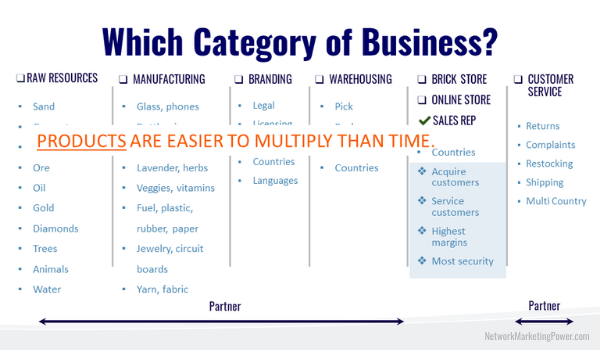
There are businesses that extract the raw resources. Once they are extracted, they go to a manufacturer – who takes the resources and makes things out of them.
Then there’s businesses that do the branding, packaging and legal stuff. After that, there’s businesses that do warehousing and shipping.
Then, over here, there has to be somebody who gets to sell it. I have found the most profitable and secure location of any business model is to be the customer acquisition person. That’s number one for me because in this category it has the highest margins and the most security.
And then on the other side of customer acquisition is customer service – and these businesses handle all support-related issues like returns, complaints, product restocking, etc.
For a more in-depth discussion on these categories please see What is Network Marketing (Very Simple Explanation).
Why Choose Network Marketing to Partner With?
As a business owner, the ideal scene for me is to partner with somebody who handles the raw resources, the manufacturing, branding, packaging, legal, warehousing, shipping and customer service.
I choose to partner with Network Marketing. Network Marketing companies tend to be much more devoted to a particular product category. Compare that to similar businesses like popular affiliate programs (ie: ClickBank), that mostly have gimmicky type of products.
They’re not devoted to the brand itself. In other words, they put up a product but it’s typically not a high-quality product that I could get behind.
If you want to look at this more closely, you can watch a few other videos where I compare this type of business model: Network Marketing vs. Amazon Sellers
How to Make Money in Network Marketing
How we make money in Network Marketing is very simple. It’s all about how to get customers. You generate a lead, contact them, send an appointment, do a presentation, follow up, get a customer, serve the customer and you make money.
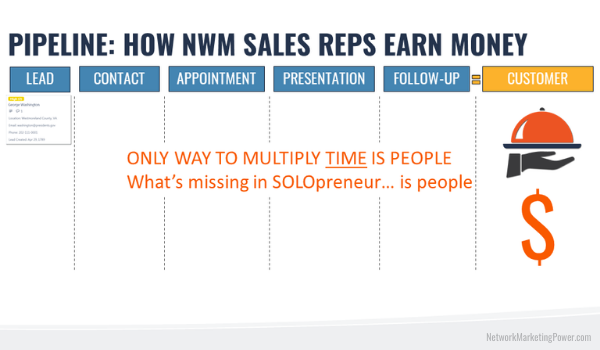
Doing these steps in the Pipeline is the only way I know of to multiply time through people. So once I get good at doing these steps to get customers, I want to do these same steps to get other sales reps.
They get the same compensation plan that I get. It is different from the employee model. You are paid on what you do. And if you can get customers, train another to get customers, they get the same compensation plan that you get.
And so then I’m going to make 100% of what I sell, and I’m going to get a smaller commission (5%, 3% or 2%), from the sales of those I trained. There’s a benefit for me training other people to do so.
I hope that this discussion has helped you to understand a comparison between a job and Network Marketing. Obviously, there was no way for me to do a price comparison like I did, with the others, because salaries are all over the place.
But what I commonly see is that if somebody is going to make $100,000 in a job, they had to go through education to get there. They had to go up the corporate ladder and that it takes either equal time or less time in Network Marketing to do the same.
What do you think? Comment down below and let me know.
P.S. If you don’t have a team, haven’t recruited anyone (or less than 10 people), this is THE course you should get – Network Marketing Training Course