Network Marketing vs Real Estate

In all my years of network marketing, there was one objection that I was never able to solve…
That is, “How does NWM compare to other industries?”
“Am I better off doing something like real estate?”
It’s a hard question to answer, because most industries keep their internal statistics private. You can’t find the data — especially the right data to do a proper apples-to-apples comparison.
But last year, we found a clue from a small Texas town that published some stats, which set my team and me on a journey to figure this out once and for all.
We spent almost a year pouring over the numbers, and I have to tell you, I was honestly surprised to see the final result.
So here’s my side-by-side comparison of network marketing vs real estate. (According to the data, one of these is FAR superior than the other.) Enjoy!
How Sales Reps Earn Money
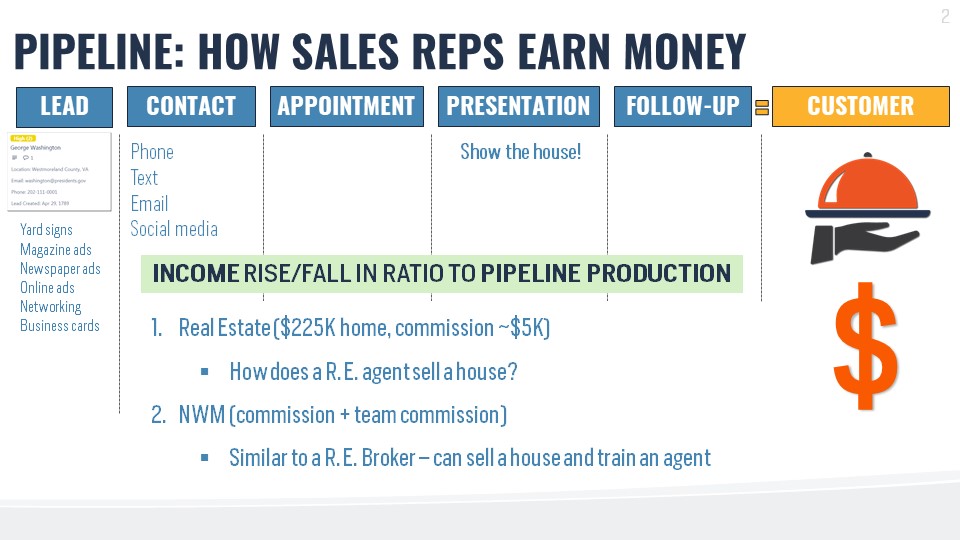
Let’s start off with what it takes to be successful in business. I want you to understand how both real estate agents and network marketers earn money.
Everybody in any sales or customer acquisition or human resources department has to acquire employees, acquire reps, acquire agents, and acquire customers. The acquisition process is the same.
You generate a lead, you contact the lead, you set an appointment and you do a presentation, you follow up and then you get a customer or an agent or a rep. This is called the Pipeline.
Income rises and falls in ratio to the pipeline production. If somebody’s not able to hire the right person for the job, what is that? Well, it’s because they didn’t generate enough leads (applicants) and move them across the pipeline.
If they can’t get a customer, well, why not? If it’s a real estate agent, they’re not putting enough leads in front of the house.
Let’s go through the pipeline steps together on this.

Let’s say that a real estate agent sells a $225,000 house. That’s the average. The income (commission for that sale) is around $5,000. What’s the process that the agent goes through? First, is generate leads. The agent is going to:
- Put up yard signs
- Put ads in magazines
- Run ads in newspapers
- Run ads online, like Facebook or Google
- Go to networking events and/or investor events
- Give out business cards
I remember being at a Halloween party once, and a real estate agent was passing out his card at the party. There are all kinds of ways that realtors can generate leads.
Next, we move to contact. People connect with realtors in various ways. Most often, you’re sitting in your car, looking at the realtor’s for sale sign and you call. Realtors also use text, email, and social media.
What’s the presentation? The house. They’re going to set an appointment to show the house, or they do an open house all day on Saturday.
And finally, they’re going to follow up and at that point the realtor will either get a customer, or a “not interested.”
I want you to think about that process. If a real estate agent knows their game, what they’re really trying to do is find the person who wants the house that they’re selling.
I know that when I’ve looked at houses, I go into a house looking for something very specific, and I know that agent has no idea what I’m looking for. For example, I might be looking at where I am going to put my office – that could be my primary thing. I remember looking for an investment house once, and I was looking at the curb value.
My point: the customer is looking for something, or has a specific need or want in mind when looking at properties. So for the agent selling the house, it’s all about quantity of leads to find that person who wants that house. It’s not about convincing somebody.
When somebody really knows their trade, that’s the game. It’s not about trying to take somebody who doesn’t like the house and making them want it. That’s not what we do.
How Did This All Come About?
So you may be wondering, why I’m focusing on real estate. And the answer is, I’m a curious person.
I happened to Google “average income of a real estate agent in 2019,” and I found the data and it was $41,289, according to Forbes. Right down below it said $41,395 and $53,899. It was a range. And then there was another amount of $52,000. And I thought, “Why is there variable data? Why isn’t it just a statistic?”
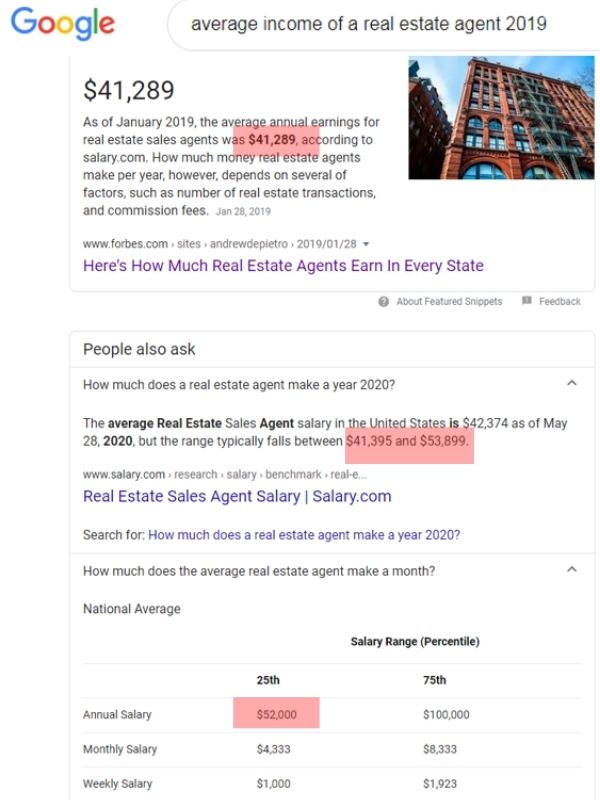
I became curious, and that’s when I launched the research team to try to figure out why, because I was wondering, “Is it everybody in real estate that’s ever had a license? Or is it only the active realtors?”
Because I remember some of my family members who had a real estate license and they hadn’t sold a house in 10 years. Were they part of the calculation? I was very curious about this.
Now, my research team just happened to get lucky. That’s the way I view it. We found a small Texas town that revealed the number of people who passed the licensing exam. And then that gave us the query to be able to find more and more data points.
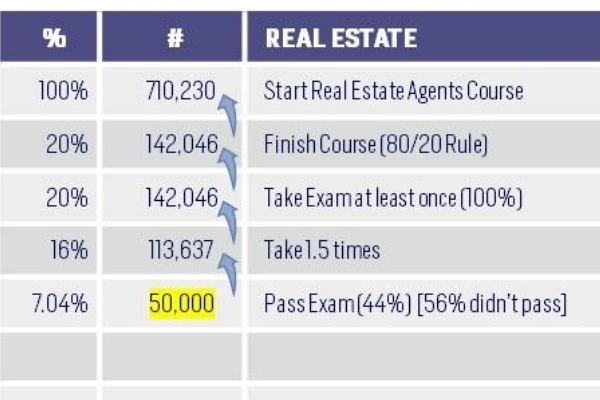
The bottom line is that 50,000 people become real estate agents per year.
44% pass the exam. That means 56% didn’t pass, and so what we arrive at is that 113,637 people took the exam. You can take the exam three times in a year. We average that at 1.5.
Next is how many people actually finished the real estate course? What course? Well, there’s a real estate agent course, and it takes about 57 ½ hours to complete. The course is about contract and regulatory law. How many people actually finished the course? The numbers showed 142,046 people finished the course and took the exam at least one time. (This was one piece of data I was curious about.)
And finally, we can get the number of people who start the course. It ends up that you needed 710,230 people in order to get to the 50,000 that would become agents. So the key numbers here are 710,230 people start out taking the real estate agents course, and 50,000 actually pass the exam to become an agent.
With these numbers, I now had the data needed in order to compare to network marketing. That’s how we can do a side-by-side comparison. But first, let me show you a few more pieces of important data about real estate.
Of the 50,000 agents that pass the course and get a license to be a real estate agent, only 37,500 agents sell at least one home. That’s 75% of them. Now I have a question for you, and I want you to really think about this:
How did we lose 12,500? Why did 12,500 people not sell a home? I have the Pipeline right here to remind you.
If 37,500 did sell one home, it meant that they put enough leads across the pipeline in order to sell one home. But the 12,500 did not put enough across the pipeline. Whatever was in this course, it may have taught them regulatory law, but it didn’t teach them the Pipeline.
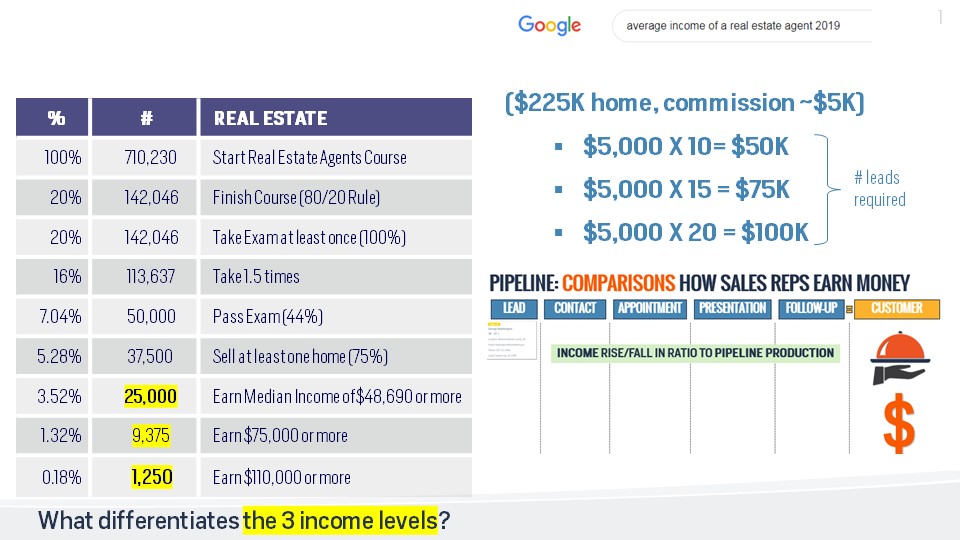
Let’s take a minute and look at real estate income. In the next group up, we have 25,000 real estate agents that earned the median income of $50,000.
9,375 agents earned $75,000 or more, and 1,250 agents earned $110,000. All these numbers add up to 3.5% earn the average.
In a book called How to Lie with Statistics, omitting data is listed as a way to make statistics look different than they are. That’s clearly the case here, because they start their math at the number that passed the exam, not the number of people who started out and said, “I want to be a real estate agent.”
Let’s break this down. A $225,000 home commission is $5,000. $5,000 x 10 is $50,000. In order to earn this median income, a real estate agent needs to sell 10 homes.
Let’s say that it requires 100 leads across the pipeline in order to sell 10. (I don’t know what the actual numbers would be; I’m not a real estate agent. Maybe somebody can share those numbers with me.) But the concept is always the same in the game of marketing, which is: “How many leads did they have to move?”
Let’s just say that it was 100 leads, or 1 in 10. The people who did not do that did not advance in the income bracket. Fifteen houses sold is required to make $75,000. That would be, let’s say 150 leads across the pipeline. Only 9,000 people were willing to do that. And then only 1,000 agents were willing to put the quantity required to make $100,000.
Network Marketing vs Real Estate
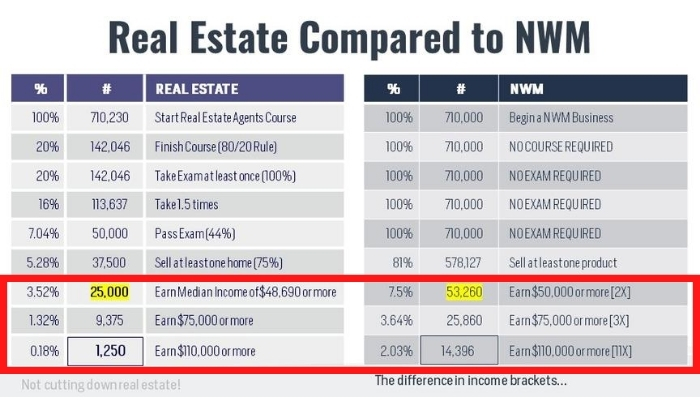
Compared to Network Marketing, we took the same quantity in the same way the data was extracted for real estate. And then we just filled in the blanks.
There is no requirement to do a network marketing course. It’s recommended, but no course is required. 81% or 578,000 network marketers sold at least one product. That means that a whole lot didn’t. 200,000 didn’t. What didn’t they do? They didn’t move enough quantity of leads across pipeline. That’s it.
7.5% earned the median income, $53,000. That’s two times more than what real estate produces. 25,000 network marketers will earn $75,000 a year. That’s three times more than in real estate. And then 14,396 network marketers will earn $110,000. That’s 11 times more.
And again, this isn’t any different. You’ll hear a lot of excuses, but it is quantity across the pipeline. And as you train a sales team, it’s quantity across the pipeline. If you train your people to do quantity across the pipeline, it’s not any different than a real estate broker that trains his or her agents to do quantity across the pipeline. That’s the game.
When someone claims, “Most people fail” or “Only a few succeed” or “IT doesn’t work,” what are they really saying?
Conversion Increases with Quality Conversations
Let me bring it back to where I can really assist here. Between each of the columns in the pipeline, there is normally some communication that goes on.
You generate a lead and then communicate with that lead. The better you get at it, the better you’ll be at the pipeline. As you contact them, your communication is you asking pertinent questions – what they’re looking for, things like that. Then you’re going to be better able to connect the house to the client, or prospect.
It’s the same thing in Network Marketing: “What are you looking for?” Next is setting the appointment, following up just before the appointment, or confirming the appointment, and then doing a presentation, like showing the house or sharing a video about your product.
The better that you get in each of these columns, the better the conversion, but it is always quantity that wins the game. If you can add quality, your conversion rates go up. And this is the same in every industry.
The People Who Win DO the Pipeline
For those people who have said things like, “Most people fail in network marketing,” or, “Only a few succeed,” or, “It doesn’t work” – I would suggest that you keep this in mind…
When people say things like that, what they are really saying is that the reason for failure or no success is because the person didn’t do the pipeline. The people who win, the people who succeed, do quantity across the pipeline. Those that are the top producers did quantity across the pipeline. I hope that helps you to understand the basics and the fundamentals of all of this.
There’s one more point that needs to be addressed. And that is, I know where all of the anti network marketing data comes from. There was a gentleman by the name of Jon Taylor, and he and I were in the same company at the same time. I had joined a company, and I worked at it for five years. I retired for 18 years and didn’t do anything.
Jon, in the same company about the same time, “worked at it” for a year. He couldn’t make it work. He decided that “it” didn’t work. What was it?
“It” was that company.
He tried everything he could to bring that company down. It’s a $2 billion company now. He didn’t bring it down. He diversified and he said, “Well, the whole industry is flawed. The whole industry is a scam. The whole industry…”
The bottom line is that he had poor sportsmanship. That’s really what went on. He spent his whole life trying to prove that network marketing didn’t work, was a flawed business model, and most fail, few succeed, et cetera. He wrote a bunch of articles that then got picked up by The Washington Post, The Wall Street Journal, The New York Times, and a bunch of blogs.
The media quoted it as FTC research. No. If you look really, really close, you will find that Mr. Taylor’s remarks come from the public comments on the FTC’s website. (Not a lot different than people who comment down below on my videos and blogs.) He simply uploaded his PDF and shared it with people. And because it’s got that URL, people think that the content is by the FTC. It’s not.

You can choose if you want to be on the negative side or you want to be on the positive side, but the bottom line is, it’s the pipeline and it’s quantity across the pipeline that creates success in real estate. The pipeline creates success in network marketing and everything else.
Real Data-Driven Credibility for Network Marketers
I am in no way putting down real estate. I applaud anyone who wants to be an entrepreneur and go into business. I was actually very surprised when I saw the numbers. I thought, “What? You’ve got to be kidding me.” But then after a bit, I figured out, yeah, that would make sense to me. The reason that it would make sense to me is that if a person in real estate moved 200 people across a pipeline in order to sell 20 homes and make $100,000, at the end of the year, they have to do that again next year.
Houses aren’t consumable. Network Marketing tends to be consumable. You would have more of a compounding effect of that volume. Yes, there are going to be some people who get off auto delivery. They don’t want the product anymore. They don’t want to be reps anymore. You’re going to have attrition, but there is a compounding effect that goes on. Each year, if somebody is still working in the pipeline and they trained their team to work the line, the quantity will take over.
If you take a look at the chart comparing real estate and Network Marketing above, you will see that what’s going on is that these are teams doing the pipeline.
I’ll just make it really simple.
In real estate, it’s a person or two or three doing the pipeline. In network marketing it’s a team of people doing the pipeline. The broker has a team, normally not as big as what network marketing develops, but the idea is that a few people are doing the pipeline in real estate to create income, as opposed to the network marketing team. That would be why there are eleven times more people making $100,000 in network marketing than in real estate.
This is not a criticism of real estate in any way. I applaud anyone who wants to go after it and be an entrepreneur. And I don’t want this video or article to become a prospecting method on real estate agents.
The reason I’m publishing this information is to give real, data-driven credibility to network marketers everywhere. Our industry is often criticized in the media, with people saying “few make money,” but when you break it down against an “accepted” industry like real estate, you’ll see that the numbers speak for themselves.
I’d love to hear what you think about this data. Was it helpful to you? Let me know in the comments below.
P.S. If you don’t have a team, haven’t recruited anyone (or less than 10 people), this is THE course you should get – Network Marketing Training Course