The Mechanics of Wealth & Time Freedom – Early Stage to Advanced

I’m about to walk you through the mechanics of building real wealth and time freedom from the perspective of somebody who has actually done it. I’m going to give it all to you, step by step.
But my reasons for publishing this probably aren’t what you think.
The reason I’m doing this is because there’s a young woman on YouTube named Kylie who has built a following for herself by ridiculing and embarrassing people in the network marketing industry.
She’s carved out a career by making derogatory (and often incorrect) comments, and the only way that I can actually show you WHY and HOW they’re not true is to actually show you the mechanics of wealth and time freedom.
It’s all here. Read this article, and you win big.
OK, here is her quote. Read this, and then I’ll explain…
“One of the main reasons is that it seems like the upline — so people at the top, the people who make all the money, the people who got in five years ago (three years ago if it’s a newer MLM) — those people don’t seem to be doing anything. And just seems like they’re kind of barking orders at people and their little cronies and the people at the bottom are doing all the work, killing themselves to make sales.”
Sounds pretty rough, right? Let’s address these one by one, starting with the people at the top; the people who make all the money; the people who got in five years ago…
Debunking the “People at the Top Make All the Money” Myth
A lot of people have this confusion about network marketing because this line gets regurgitated over and over. It’s false. It’s untrue. And when you think about it, that whole idea is plain dumb. Let me explain.
Whenever someone throws that line at me about the people at the top, I always ask, “At what level?” And it usually shocks or stuns them. Nobody expects that response.
They’re usually like, “Huh? What?”
What happens is that I end up destabilizing them for a moment, because they don’t understand what I’ve just asked them.
Here’s what I mean — the “top” could be a thousand levels deep in the organization.
Kylie thinks that because you get in first or second or third, then you have a better advantage. (“All those people who got in early make the big bucks.”) It’s not the case!
I’ve got 38 people on my team (below me) who make more money than I do! And I ‘ve got 57 millionaires on my team and 5,401 people at last count averaging $250,000 a year. So you can understand my response when anyone says “the people at the top.” In the real world, it means nothing.
The People at the Top – a Visual Explanation
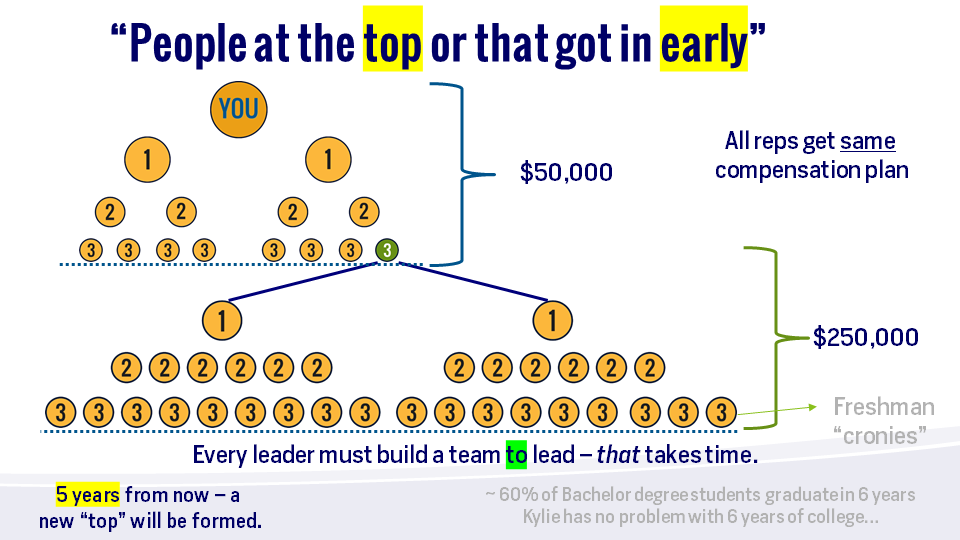
Let me explain to you so that you can see it. In every network marketing company, there is a cutoff. In my chart, I have the level at three, but there are some companies that pay six or seven.
I have drawn a line here after my third level to show you how you could realistically build a bigger organization than mine. Maybe you saw the business bigger than me or outworked me. But you’re on my third level, and it cuts off right there for me, and I don’t get any more sales volume out of that.
If you built a bigger organization than me (more sales volume, not people), you would make more money than me. Let’s say I was making $50,000, you might be making $250,000. See my point?
And so when Kylie says, “the top”, I have to ask, “which top?” The top of my organization or the top of yours? Or the top of that person twelve levels below you who is really crushing it?
Hear me on this — Every person, when they come into the business, they start at the top of nothing. And then they build their organization.
That is the same way every business owner in the world starts a business. They started at the top of nothing. And years later, we gawk at them and say, “Wow, that’s amazing! Look at Apple, look at Nike, look at Procter & Gamble… they’ve got all those people.”
It’s not about where you start. It’s what you have the ability to build.
Debunking the “People Who Got in Early” Myth
Kylie also made the comment about the people who got in “about five years ago” — implying they’re now sitting back making money without doing anything for it.
Think about it this way… Five years from now, a NEW top will be formed. Some of the people in the organization — not everyone — will have worked hard and built their businesses (gaining customers and reps). Some will stagnate. Some will have quit. My point is, after five years, the organization will look very different, and there will be a NEW top earner, based on who has produced the most sales volume.
But Kylie will not accept that, so let me articulate it a different way.
In our chart, let’s look at the people at the bottom, and let’s call them freshmen. Then the next level up… let’s call them sophomores. When you think of it like an education system, you get a clearer picture. The longer people stay, the more they tend to advance.
According to the National Center for Education Statistics, 60% of bachelor degree students graduate in six years. So in six years, do you think there’s going to be new freshmen that show up? Probably. And so they are the new kids, right? They’re coming on campus and they see these upperclassmen and they’re like, “Oh my gosh, these guys are about to graduate. I’m going to be there someday.”
Yeah, Kylie makes fun of them. She calls them cronies.
You can read it yourself in the quote above or hear it in the video. 😲
“Seems Like” She’s Manipulating You
Let’s move on to the second part of what she said. And notice that she puts a qualifier word in there, “Seems like.”
“… it seems like the people who got in five years ago don’t seem to be doing anything. Just seems like they’re barking orders at people and their little cronies and people at the bottom are doing all the work, killing themselves to make sales.”
Why does she use this word “crony?” I’m going to let you decide that. My interpretation is that it’s a manipulation tactic. She’s trying to pre-frame you; she’s trying to make you think to yourself, “Ewww, I wouldn’t want to be a crony.”
And what about “barking orders?” She offers us no example of that — never shows anybody barking orders. She just threw that in for effect.
But let’s say she did have an example… If somebody is barking an order, they’re not going to last very long in network marketing. It’s a voluntary organization. You can quit any time if you don’t enjoy what you’re doing.
What I did see an example of is an activity sheet — or a task list — which is basically an upline leader saying, “These are the things that you need to do if you want to reach the goals that you’ve set.”
But Kylie’s attitude is like, “You can’t tell me what to do. You’re barking orders at me.”
Here’s a simple example. If you want to get up at 5:00 in the morning to catch an airplane, you’re going to set an alarm, right? In other words, there’s a task you must do in order to get the thing you want. This is basic stuff. And it’s the same way in network marketing, and any other business that you ever do. You’re going to have to do certain activities if you want to succeed. Period.
The advantage you have in network marketing is that your upline — the person who has already done it — can provide you a roadmap of “here’s how I did it.” And that would include an activity sheet of daily actions to do. But, you know, Kylie makes fun of that.
Let’s take this one step further and pretend there WAS a person who was barking orders at their team. Being a dictator or a tyrant. That’s a person doing that. It’s an individual. It’s NOT an industry.
And Kylie is trying to blanket everybody in network marketing and say, “They’re all the same; all companies are the same.” And that, my friends, is called bias. It’s prejudice.
“The Top Don’t Seem to be Doing Anything”
Let’s talk about the role of a sales manager. (We call them “upline”.) Her confusion has to do with what roles people are playing at different times. Managing salespeople is all about training and establishing and raising standards to meet goals.
- If the sales reps reach their commission goals
- The managers reach their commission goals
- And the company reaches their gross sales goal
Different roles. Everybody wins. That’s called teamwork. That’s how it functions.
Ever had employees? How long is their training?
So now I’m going to get into the mechanics of wealth and freedom, because this is where everything will start to make sense.
Have you ever hired an employee? Maybe just somebody to mow your yard, or a babysitter, or a house cleaner… and in the beginning, did they save you time?
Probably not.
You have this assumption that this person is going to come and they’re going to do a specific job and free you up. But in reality, it requires your input. It requires you to assist them and teach them how you want it done.
There’s a process that happens. And when you get a new rep, or you get a new employee, or you get a new recruit into the U.S. Navy, there is a time where you’re going to have to change that person’s routine.
When a person joins the Navy or the Marine Corps, their whole routine changes, and that is how a person actually changes over time.
I was in the Navy Special Operations, and this is the layout of our organization. I know people say it’s a shape of a pyramid scheme, but give me a break. It’s called decentralized command in the military.
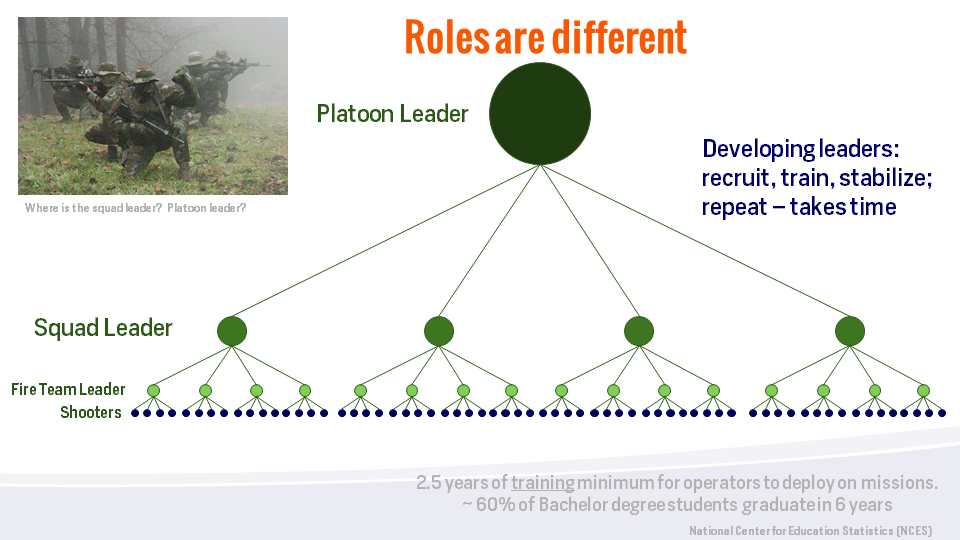
So all of these “cronies” (as Kylie would have called them), all the blue dots at the bottom, these are the shooters. And there are 4 shooters to each fire team leader.
In peace time you can expand it to 6 depending upon the operation, but in war time, it gets too chaotic and you have to organize in groups of 4, because that is typically the most anybody can manage under stress. Remember that, because she said “it doesn’t seem like they’re doing anything.”
The next level up (the light green dots) are your fire team leaders, and they are in charge of those four shooters. And then the squad leader is in charge of 4 fire team leaders.
So having said that, look at this picture for a moment, and let me ask you a question.

In this picture, we can’t really tell where the particular leader is located, but let’s just say, the person in the front is the fire team leader. And then the formation behind him are the shooters.
If you saw this photo, would you say, “Hey, where’s the squad leader? Where’s the platoon leader? Seems like they’re not doing anything!” No, you wouldn’t.
And that’s what Kylie is assuming. She’s saying, “Well, because I don’t see the squad leader or the squad leader happened to post on Instagram what her schedule was that day and she only worked two hours…”
She’s criticizing what the upline — the leader — is doing, with no knowledge of what their leadership skills or stress levels are like. And she has no clue how ignorant that looks.
There is a time — it takes about two and a half years minimum — that spec ops are going to be training a special operations recruit. 2.5 years minimum, and then they will get into the Teams (like SEAL Teams), and they will begin to work and do iterations. And during that time, you have to get along so well, you have to rehearse, you have to party, you have to do everything together, so that you learn to trust the new guy.
How the Military Develops Leaders
During the course of training, whoever shows the best leadership and ability is going to rise to be the fire team leader, and that fire team leader will advance and go to squad leader.
What they’re trying to do during the course of training is develop leaders. And the military is always developing leaders, because they’re always bringing in new recruits. The next iteration. The next generation.
And so it’s just a joke to me when Kylie dismisses the people at the bottom. Where did you think you’re going to start? At the top? You think you can go to school and just start at the top once you graduate? You can’t, because you’re the new guy. You don’t know what you’re doing yet. Give it time.
Developing leadership is “recruit, train, stabilize, repeat.” It takes time.
So a person comes in… they’re new as a squad leader, and the platoon leader is going to be working with them and say, “Welcome to your new job. Here’s what I need from you on a daily basis. During an operation I need these details — these updates — as the iterations of the day.”
(Keep in mind that our new squad leader is now in charge of 4 fire team leaders, who are each in charge of 4 shooters. So his job is to manage, coordinate, and report back on their daily progress on the mission. Suddenly their day looks much different than that of a shooter on the front lines.)
Hopefully this gives you some idea about the different roles people play in different industries, so you can see that it is NOT “seems like they’re doing nothing.”
Building a Team in Network Marketing
Network Marketing is no different. It’s yet another scenario where the emphasis is on building a team. You’re going to see a lot of activity. And what is that activity? (Hint: it’s the same activity that Kylie does.)
- Generate leads
- Contact those leads
- Set appointments
- Do presentations
- Follow up
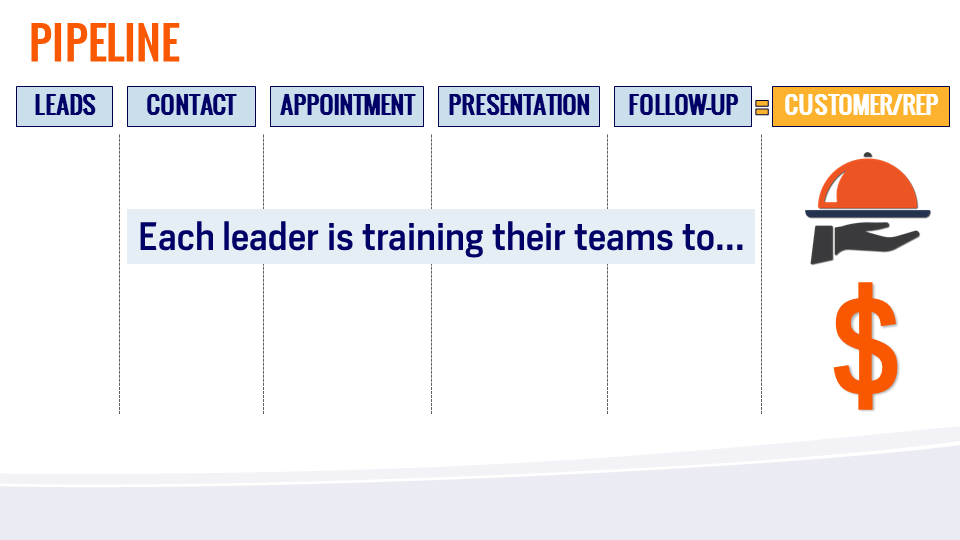
Those people who say “yes” — they are going to be your customer. You’re going to serve them. And for serving them, you’re going to make money.
Those that say “no” — they end up in a column on the far right side of your pipeline called “not interested.”
And the people who say “maybe” — you’re going to follow up with them until they decide either yes or no. That’s all it is. Simplest game in the world.
Early Stages
Reps begin by training — and doing — the pipeline board. It’s just moving prospects across the line. Leads. Contacts. Appointments. Presentations. Follow up. It’s a quantity game.
And so when you’ve got two people, then now you need to continue doing those same actions while simultaneously helping your new people learn — and do — the pipeline.
(That was the reason that I showed you that when you hire a new person — a babysitter, yard worker, housekeeper, etc. — you’re going to be doing a lot of activity here to train them and get them up to speed.)
So you’re training your first reps, and meanwhile, you’re still trying to build more of a team. And so it’s very chaotic. This is the “paying your dues” phase. This is the “busting your butt” phase.
Once your first reps are trained, and they begin to build their own teams, you’re working with them to make sure they are training their team on the pipeline, overseeing how they’re training the team on the pipeline. Again, you are busy at this stage. Very busy.
Getting Stabilized
“Stabilized” means that the person you brought in has now built some number of teams, (depending on the compensation plan and in what company). And from there it’s keeping tabs on their progress. Keeping tabs on their daily activity. Are they acquiring new customers and reps? Are they training their people on the pipeline? Remember this is customer acquisition, the same game. We’re just repeating the process.
And so, once you have stabilized your first team, and you’ve stabilized your second team, that could be $100,000 or $200,000 a year in income. And let’s say you’re a mom who says, “You know what, before I build some more, I’d like to have a baby.”
You’ve paid your dues. Your team is growing on its own. Wouldn’t you have that right?
Look, I know the way this whole thing feels… I’ve been there.
There’s a time where you’re just churning. You’re working, you’re working, you’re working, and finally it begins to take off! And you say, “Wow, they don’t need me at all. Okay, now I can build another team.”
But you also get this break in life where you realize, “maybe there’s some other things I want to do”. At this stage, when you’ve got some stability already with the people that you’ve been focused on, you begin to step back and let them lead, just checking in from time to time, say once a week.
Just like in special operations, you reach out to your people and say, “Hey, give me a sit rep.” (That’s a “situation report” for you non-military folks.) In network marketing, it’s more like, “Hey let’s catch up; let’s touch base.”
This is what the leader is training their teams to do.
Mastering the Pipeline
Between each of these columns, the conversations are often fluid. But we draw the pipeline with columns, so you can see that each one of these categories can be perfected.
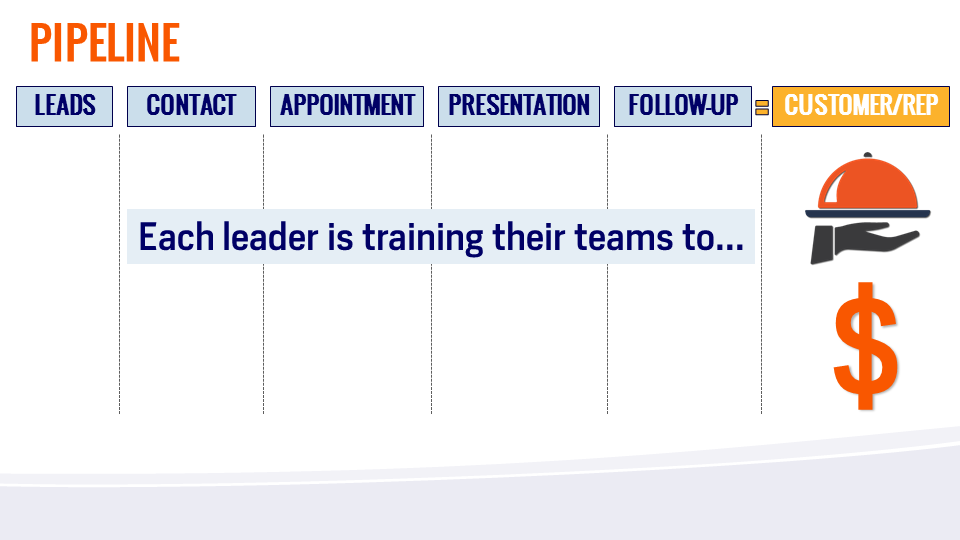
I had a hard time early on, because I was really, really shy. And so in the “Contact” stage, I was scared. I needed a lot of work in that area… And if you’ve ever felt like “I’m just not good at this,” then I encourage you to dig deeper and figure out which areas of the pipeline you’re weak in, and train on those specifically.
That’s what successful leaders are training their teams to do.
How Wealth and Time Freedom are Actually Created
“Learn to do. Replace yourself. Repeat.”
Let’s say that I decided I wanted to build and sell sheds. The first thing I’ve gotta do is learn about foundations. Measuring it out, pouring the concrete, etc. Maybe I take a vocational course, so I can get really good at foundations.
And then what I want to do (and this is where most people mess it up) is I want to hire somebody and I want to apprentice them.
I want to teach them how to build foundations — not do it myself.
This is building wealth, and it requires thinking differently than most people think. I want somebody to replace me at building foundations. In fact, I want them to get better than me.
Once that person is trained and effective at their job, I’m going to move over and learn about framing — how to put the sides on and the basics of the roof and the floor and all that stuff. I’m going to learn it myself, and then I’m going to bring somebody in and I’m going to say, “You’re my framer. And I want you to do all the framing of these sheds.”
And so he starts doing it and I correct him, and I coach him until he can do it better than me.
And then I’m going to move on, and I’m going to say, “Now I’m going to sell sheds.” I’m going to learn how to sell and compete with every other shed seller. And I’m going to learn that really, really well. And then I’m going to hire somebody or bring somebody on board and teach them everything that I know about selling sheds, because I want them to replace me. Now I own a shed business.
And that is the mistake that I’m telling you almost everybody makes! They want to build sheds AND sell sheds. And now the business completely depends on them, and they can’t sell their shed company.
Learn to do. Replace yourself. Repeat.
The reason Kylie could not catch this is because she is a solopreneur. It’s about “me.” I’m the one, I’m the star. I want my name out there. I want this. I want that. And so she is just the show, the whole show.
How Do You Replace Yourself?
I promise you, this is the secret.
#1 – Understanding. You know how to get results because of your training and your experience. That was building the foundation, that was building the framing and so forth. Therefore you are aware of what team members are doing correctly and incorrectly.
#2 – Patience. A willingness to accept or tolerate slow learning, confusion, difficulty in application without getting angry or upset.
The best example that I can think of would be teaching my 4-year-old to tie his shoes.
Just picture this situation. He wants me to tie his shoes for him, and I say to myself, “Man, I’m going to have the only kid who can’t tie a shoe as a teenager. I’m going to have to teach him to tie a shoe.”
So I get down there, and I say, “You can do it too.”
And he says, ‘No.”
Why? Because he’s failed before. And I say, “Let’s do it together. So I tell you what, I’ll hold this side and you hold that side, and you just move it over here and around this thing over here.”
And I just coax him into it. Not tying the whole shoe, but just a step of the shoe. One step in the process. And then I just keep on having him do one more step, or I just keep doing the same step until he gets stable on doing that one item.
And then I assist him on the other side. “Flip the other side over. Now twirl it around.” And I’ll create a little game about a rabbit going around a tree and all kinds of little things to get him to understand it.
It is your creativity and patience that allows you to replace yourself. That’s the secret.
How Well Can You Train Another Person?
There’s going to come a moment in your life where you realize that “it ain’t about me.”
It’s not about you and how good you are at something. It’s about your ability to train another person — to make them better than you.
In that moment, when that kid finally ties them one time and he looks up at you and he did it. It’s that moment where he is just bolstered with pride.
That is the game! Nothing else is the game.
You do it with children, and you do it with people to replace you.
And you say, why in the world would I want to replace me? I mean, I went to all this school and this education in order to become unique. But that doesn’t create wealth.
Why do businesses stay small?
- There are 32.5 million businesses in America.
- 7.7 million of those have employees.
- 24.8 have no employees.
So what does that tell you?
Every student who’s coming out of college is going after the 7.7 million companies, because they’ve been trained to be employees.
What about the 24.8 million that have no employees? Most of those businesses can’t afford them. Or worse, they don’t want to train their future competitors.
I prefer reps, not employees.
I’ve had employees. And every time they send me a resume I ask, “Do you want a salary or do you want to just go straight commission?”
“Oh, I have to have a salary.”
“Why do you have to have a salary?”
And he’s like, “Well, I just want to be covered during the rough spots.”
In other words, if a person knows his game, if a person knows how to do it well, they don’t want a salary. And that’s the fundamental difference.
You want to build people with that kind of certainty because they’re unstoppable, right? Because what is the most important job in the whole world? Selling.
You will always be the senior person. You will always be the very best. Because the salesperson is the one who pays for everybody in the company. Because of the revenue they generate. Because of what they sell.
Building a Productive Sales Team is Paying Your Dues
I just talked about you yourself being a sales person. Once you know how to do it, the reason that you want to train others is because in network marketing, you don’t advance based on tenure or how much you know.
In fact, you get the same compensation plan that everybody else gets. That’s not typical. That’s what makes us very unique, and (in my opinion) the most fair of any business in the world — because we all get the same compensation plan.
And so we can train our future competitors. In fact, we want to. We want our trainees to be better than us, because when they’re better than us, we can take a step back!
We can take a couple of hours a day off if we want to. Or we can take a year off if we want to, because we have developed a team.
So building a productive sales team is paying your dues, earning the right to have wealth and time freedom because you worked smarter. That’s what paying your dues means.
The public is okay to work 40 years at a job and retire. “You paid your dues. Good job, here’s your watch.”
But spending five years building and training a sales team, then only working two to four hours per day? Aw, that’s sketchy, skewed clearly unethical and clearly a scam. LOL!
You see how that works? You see how skewed Kylie is in the understanding of the creation of wealth, and why I had to explain that whole thing in order for you to see what I see?
So please leave me a comment below and tell me what you think about this concept of “learn to do, replace yourself, repeat.” Because that is how you have time and wealth freedom. This is Network Marketing Power.
P.S. If you don’t have a team, haven’t recruited anyone (or less than 10 people), this is THE course you should get – Network Marketing Training Course