I Can’t Do It (The Danger of Projecting Failure)
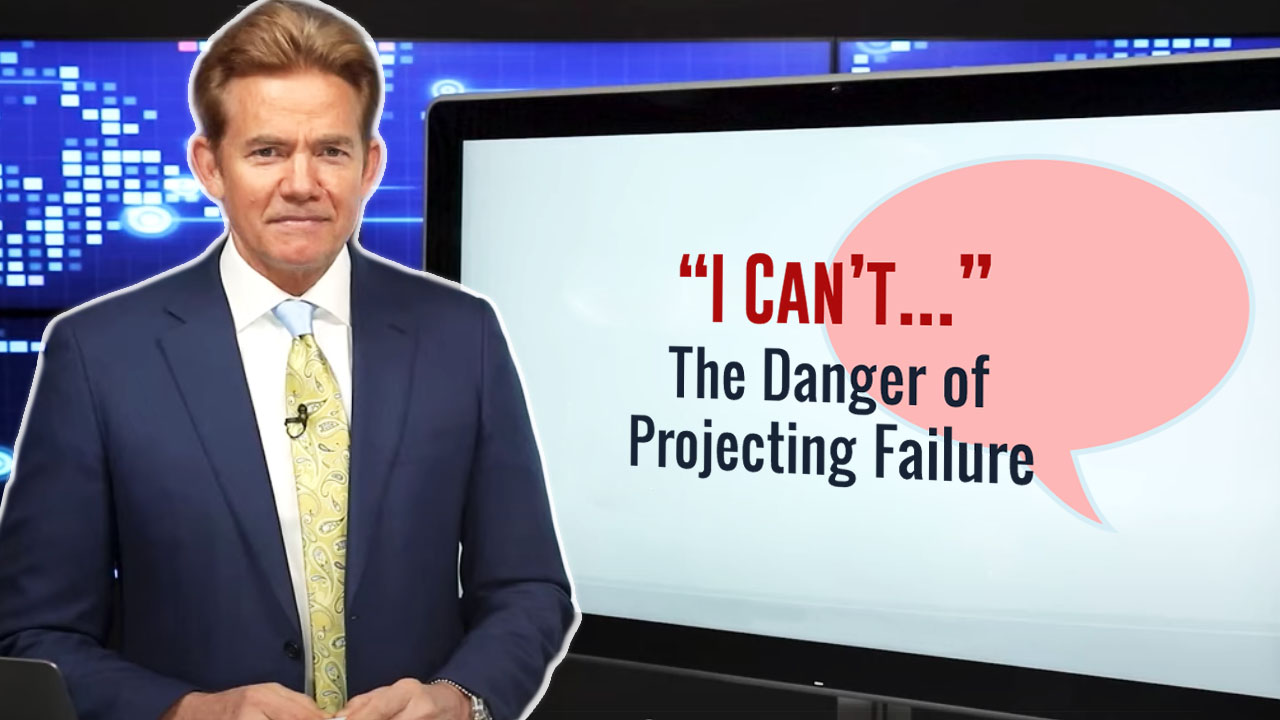
In this episode we’re continuing our series about what prevents someone from joining Network Marketing… today we’re talking about “I Can’t…”
In other words, how do you deal with a prospect who is projecting failure? Meaning, they don’t believe they can succeed in this business, or maybe down deep they’re afraid to fail.
This is a topic that’s near and dear to my heart. Sometimes, we’re dealing with years of reinforced beliefs, which can be difficult to unravel. But nobody ever said personal growth is never easy.
Are You Afraid to Fail?
This episode is closely related to a previous episode of “The #1 Hidden Objection That Keeps People Frozen” because it relates to what happens when you’re talking to people, and what clues you get about where they are in life.
“I can’t” is an indication, to me, of what I’m going to need to do. When someone tells me “I can’t” I believe what they are really thinking is: “I’m afraid to fail.”
As I meet with prospects, I have found similarities in a particular thing, which is that they’re afraid to fail.
Setting Goals – Are You Projecting Success or Failure?
A symptom of being afraid to fail is projecting failure. What do I mean by that?

Here is a calendar. It’s got some things here like Christmas and New Year’s, but I always view it as this whole idea that my calendar is what I’m putting in the future.
I’m throwing a football out here to Wednesday and saying, “I’m going to do a Zoom with this person.”
I’m throwing it out to later days and saying, “I have a meeting here.
I’m going to start some ads here,” and things like that.
Now, when you toss that football out there, what’s the immediate thought after you put it there?
Do you think, “They might not want to join. It might be a waste of time?”
Listen to that noise. It’s is a very fascinating thing for you to do yourself.
I know that when I write a goal, like a New Year’s goal, I’ll write out what I want to accomplish, and then I’ll immediately think about how difficult it’s going to be.
I’m going to have to do something different if I’m going to achieve that, because it took all I had to get me to my present place, and if next year I want to go up by 50%, I’ll have to do things differently. That would be a logical conversation.
A person who throws that football out there and says, “I can’t,” is their own worst enemy.
That’s the problem.
What is the person projecting? Failure.

I might project whether or not this is going to be difficult, but I’m not projecting failure. It’s a fundamental difference.
When I have people who say…
I’m not a salesman…
I tried it…
I can’t do it…
I don’t have time…
I don’t have money…
I don’t know how…
I don’t know anybody…
When they say these types of things is when I know they’re projecting failure and they’re afraid to fail.
The Tougher the Failure, The More You Grow
That is the fundamental difference: Afraid to fail.
I know I’m going to fail a lot of times, and I welcome it because it is what makes me better.
I’m not going to try to psychoanalyze something like this, but I know I have had failures that were more impactful than others.

I think that sometimes somebody just gets a really, really bad idea of something. Maybe they tried something, and that particular part didn’t work and it stung.
I’ve shared one of my “tried it and it didn’t work” experiences in other episodes. I had a girlfriend who dumped me and it was really impactful.
That was a failure, but it was probably the most awesome failure I’ve ever had because of what I got out of it. You want to talk about growth!
That’s why I say, the tougher the failure, the more growth there is.
When my dad died suddenly, it was impactful, but man, did it teach me so much. It took me a while to get that epiphany.
I said, “Man, am I just going to cry for the rest of my life?” It had been seven or eight days and I was just a mess, and hurt.
And then I remember driving down Ventura Boulevard and thinking, “Hmm, how long am I going to mourn? Whoa, nobody can tell me the answer to that but me. Here’s what I’m going to do. I’m going to mourn for another two days, and then I’m going to quit and I’m going to focus on what he added to my life.”
I can’t tell you how many people I’ve been able to help because of what I learned in that experience. In fact, just today someone stopped by whose wife had just died. His grandmother used to own the property that I own now.
He told me they were planning a funeral and wanted to show a video of the farm, because this was her favorite time; being on the farm, playing in the river and all these things.
He showed up crying at my door, asking if he could shoot some video of the farm.
I said, “Yeah! Her spirit is all over this place.” I talked to him and I said, “I remember when my dad died.” I told him about it.
He stopped for a minute and he looked at me and said, “I’m so glad your mom and dad got together and had you, because you are incredible. Do you like to fish? Because I’ve got a whole bunch of people who go fishing and I want to hang around you.”
The thing that you’ve got to get out of that experience is that, in the failure is where you grow.
I don’t know that you grow more in any other place than failure. Yes, I study. Yes, I do. I read a lot, but failure is where I grow the most.
Don’t be afraid to fail.
When you hear someone who is just self-invalidating themselves, and saying these phrases (“I’m not a salesman, I tried it, I can’t do it. I don’t have time. I don’t have money. I don’t know how. I don’t know anybody,”), it could be pessimism, or it could just be that they’re afraid to fail.
It’s a little bit of a journey to walk the person through that mindset and help them overcome it. You get to choose whether or not you want to take that journey with them or not.
Adopting a New Idea of Success
I remember when I was in the military and somebody would say something like, “Man, if it wasn’t for bad luck, I’d have no luck at all.”
I laughed, and then I took on that phrase and I began to say it to other people who hadn’t heard it before, to get them to laugh. It’s a bit of self-invalidation, because it means, “I don’t have any luck, or I have bad luck.”
If you can,just picture that you heard a phrase from somebody else and adopted it (it wasn’t your original idea, but you adopted another person’s idea, sometimes that’s the way that happens), it just goes away like that as soon as you begin to project out success, as opposed to projecting out “I can’t.”
When you get somebody who says, “I don’t have the money, I don’t have the time,” it could just very well be a projection that they don’t even know, because they heard their dad or someone say it.
My dad always used to say, “I don’t have the money. I can’t afford it. I can’t afford it. I can’t afford it.”
My sponsor who brought me into network marketing, said, “How long have you been saying that?”
I said, “Saying what?”
“That you don’t have the money. You can’t afford it.”
I said, “Forever.”
He said, “Who said it before you said it?”
I said, “Everybody. Everybody in my family said I can’t afford it.”
I had just adopted it as me, but it wasn’t me. Why would it be me?
I’m giving you the idea so that you’re able to listen to what the person’s saying when they’re saying these kinds of things: “I don’t know,” “I don’t have,” “I can’t do,” “I tried,” “I’m not a___”
“I’m not a___?” Hmm. Does that mean that somebody put you into a clone and you can only be one thing and not another thing?
The other day I heard someone say, “Man, you’ve changed, Tim!”
I said, “How far back you want to look? I’ve been changing since the day I was born.”
The Ideology of “I Can” vs “I Cannot”

It’s “I can” versus “I cannot.” Pessimism is an ideology and optimism is an ideology and neither is hereditary or long-term. They’re both ideologies.
I’m not trying to change somebody from pessimism to optimism. They can be whoever they want to be. I just can’t have them as a business partner if they’re pessimistic, because it’s really annoying and they don’t get very far because they’re always undermining their own ability.
I hope you can see that.
Get Into Action, Then Raise the Standards
If the person sees their level of success as being so thin that they can get a job if they’re lucky, then I can’t get them to see how big they are because they keep putting a lid on it all the time.
They’re throwing that football, knowing that it’s not going to go anywhere. They go out and try to prospect, and try to move people across the Pipeline, but they’re undermining it the whole way.
When I throw that football on a prospect, and I’ve got this meeting set up, I know they’re going to join. That’s not the issue. The issue is if I can facilitate that person wanting to leap into the pipeline or not. If I can do that, then I can get them moving on it. Then I can start setting standards, and then raising the standard, which is how any elite person is ever created.
Tell me what you think about this. Do you think pessimism is hereditary? Do you think it’s an ideology? Do you think it’s lifelong? I can’t call it a disease, but is it lifelong? Do you have to have it all the time or can you change? What do you think?
P.S. If you don’t have a team, haven’t recruited anyone (or less than 10 people), this is THE course you should get – Network Marketing Training Course