Traditional Business vs. Network Marketing – Who is More Fair?
Is a traditional business more fair than Network Marketing? Who’s overpaid, and who’s getting the short end of the stick? You might be surprised at what I’m about to say…
To start, there’s an anti-MLM lady on YouTube talking about it, and she’s basically trying to justify why a CEO’s income is so high, as compared to the employees.
“When these people in multilevel marketing companies say, ‘Oh… your corporate job is more like a pyramid than anything because the CEO is at the top and all these people are at the bottom…’ Well that’s because the CEO has proportionally more risk than anybody else in the company, right? So these people are undoubtedly in a very fair business, which most probably are, and they operate within the rules, I’m sure. The CEO [is] in charge of firing people. All the decisions are on the weight of their shoulders, the lives of people in the business. And if they get paid, it’s all weighted on them, right? So these huge decisions that they have to make, they have higher risk than somebody who’s just, you know, working at the very bottom. They just got in there, they’re just doing office work or something. They have proportionately higher risk. That’s not the same way that a multilevel marketing company works. It’s all skewed…”
Okay, the big thing I want to address is that “in a very fair business” (she’s calling out that this is the standard) the CEO is in charge of firing people, and the decisions, and if they get paid, and all of that weight … basically saying their risk is more and higher… and I think she restrained herself from actually saying it, but she’s implying that this justifies their higher pay.
Let me just say that I’m not opposed to the amount a CEO earns. But I want to point out a couple of things…
#1 – Network Marketers just have different goals, right? We don’t want to be in a position to be fired, and we don’t want this “IF we get paid” thing either.
That’s what we are all about. That’s our battle cry.
We want to be able to get a pay raise when WE want a pay raise. We want to not be at constant risk of somebody firing us. That’s what our battle cry is all about.
Don’t people in Network Marketing claim that traditional business is just as much of a pyramid?
Years ago, I was the original person who came out with the conversation that each level of a corporation (a traditional business) makes less money all the way down.
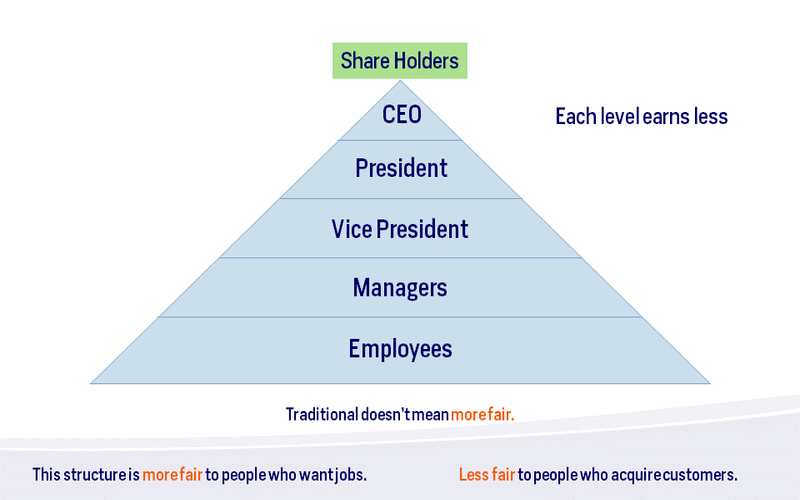
The CEO makes a certain amount, and then the president makes less.
Then the vice-presidents make less than the president.
Then the managers make less than the vice-presidents.
And then the staff and employees make less than the managers.
That’s all that I was saying. I wasn’t saying that it’s a pyramid scheme, although it is shaped like a pyramid.
(In fact, most organizational structures are shaped like pyramids. But the shape has nothing to do with it.)
And so if you’re in Network Marketing, don’t say that a traditional company is a pyramid scheme, because it’s not. True, each level does make less than the one above, but this really gets interesting when you contrast it with a Network Marketing business.
When Network Marketing was first taken to court in 1975 (the Amway Corporation), one of the things the prosecution was trying to prove was that each level made less money, and they were utterly shocked to find that there were people way down in the organization who were making a whole lot more!
And so the structure of the organization did not at all have anything to do with the amount of money somebody made.
The first person in — “at the top” so to speak — could have made as little money as a person who just started yesterday. Likewise, people “below you” in your downline organization can make more money than you do — it’s all based on production.
And so, you tell me which model is more fair, for people who actually produce?
When Traditional Business is More Fair…
This might surprise you to hear me say, but traditional business is a more fair structure for a certain group of people… for those people who want a job.
I’m not the kind of person to try to push somebody into Network Marketing at all. I’m looking for people who want to own their own business. And so I would never invalidate somebody just because they want a job. That is their prerogative.
But this doesn’t necessarily mean traditional business is always a more fair arrangement, and that is where Kylie took it too far, because I do believe traditional business is LESS fair to another group of people… people who are acquiring customers.
Kylie made the comment saying that the CEO has got all of the burden, but how does a CEO make money? The only way a CEO makes any money is because of the sales team!
The sales team goes out and acquires customers, and every employee in a corporation is dependent upon the sales team. The sales team has the most amount of skin in the game.
The sales team are the players on the field. They are not people on the bench. They’re not people in the stands. They’re not people on the TV. They are the players that are going to get it done or not done. So again, I say that this structure is LESS fair for a person who acquires customers.
The other thing is that she is saying the CEO (and I think she’s assuming that the CEO owns 100% of the shares) makes most of the money in a company.
But I just want to make sure that you understand that when we talk about where most of the money is, it’s not with the CEO! Let me explain…
The REAL Wealth Gap in Business
There’s this conversation out there in the media saying CEOs make too much — that there’s a disproportionate amount of income that’s spread among the organization.
It’s not the CEO, but the shareholders that are making all the profit.
We don’t pay much attention to them, because they’re not in the org chart. But it’s the shareholders making the $9 Billion in profit, while the CEO might be taking home $1 Million or let’s say $5 Million a year.
This big narrative in the media is talking about the pay gap between the CEO and the staff, or they’re arguing about the difference between the female earnings versus the male earnings in the same job post… But they’re missing where the big, big gap is!
Let me give you an example. We’ll use Proctor and Gamble (P&G). They’re a large well-established company that sells toothpaste and toothbrushes and soap and all kinds of stuff. And let’s suppose that this is a traditional company.
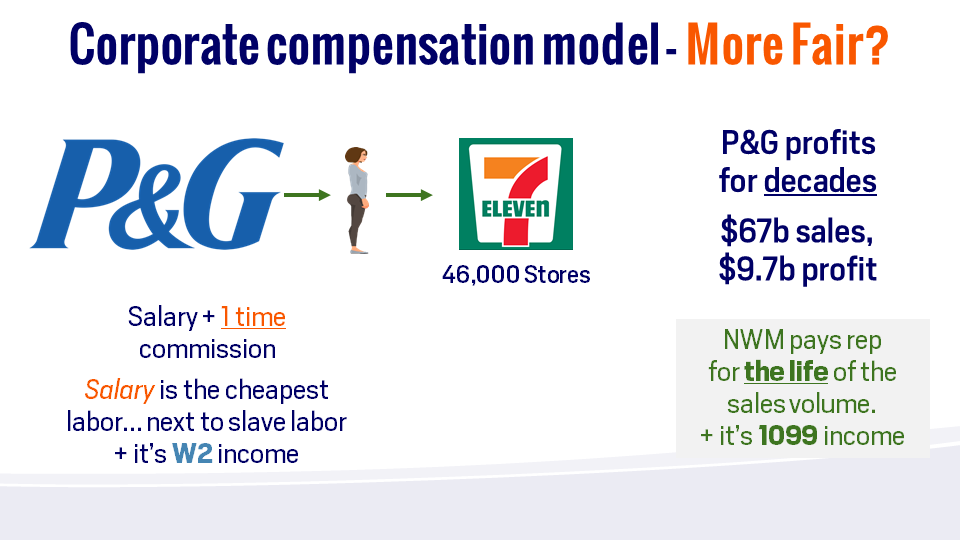
So P&G goes out and they’re going to hire a sales rep of some kind. That sales rep is going to say, “I need a salary.”
And why does she say, “I need a salary?” Because just in case she’s not able to make the sale, she wants the company to cover her.
But there’s the rub. You see, that’s a sales person who’s not quite certain about her ability to execute all processes that are in a sales cycle. And by that issue, she is going to lock herself into a salary and that means “contract”.
And therefore, if she happens to land a big deal — let’s say 7-Eleven with all their 46,000 stores — to take Procter and Gamble’s products in there, then she’s going to earn her salary, plus a one-time commission (depending on what her contract says, of course).
But Proctor and Gamble is going to make the profits off of those 46,000 stores for the life of that contract! As long as 7-Eleven is selling products made by P&G, they’re getting paid over and over again, for decades. P&G does about $67 Billion in sales, $9 Billion in profit. The reason they can make so much, year after year, is because their sales reps acquired the customers and they only paid them a small salary plus commission.
Remember, in our scenario, the sales rep was the one that acquired that big customer with their 46,000 stores. And yet, she only got paid once.
Do you see where the REAL wealth gap is? That’s the big gap.
When Network Marketing is a Much More Fair and Equitable Model
What Network Marketing does instead is they say “what you acquire, you get for the life of that customer.” That’s a big deal!
Traditional business is not the best model for a person who acquires customers. Network Marketing is a far better one.
In traditional business, employees earn W2 income, and that is not good income. A lot of people get a salary month after month, and it’s W2, so they don’t get to write off any tax benefits.
Network Marketing also pays you month after month (for the life of the customer/sales volume) but it’s 1099 income, which means you can legally and ethically write off expenses that you have in the acquiring of customers. This is a huge perk of being a business owner.
Who Really Has the Most Burden?
Just like every sports team depends on the players on the court, every employee and shareholder of a company depends utterly on the customer acquisition team. That’s where it all goes down.
And so the person who acquires customers does have the most burden. They have the most weight on their shoulders. I’ve been CEO, and I know that position, and typically the big weight on their shoulders is whether or not the sales reps are going to come through and land those deals.
Network Marketing representatives are the customer acquisition arm of a Network Marketing company. That is where they sit. So because of their importance, their relationship with the company is a little bit more of a partnership, as opposed to an employer.
You’ve got the Network Marketing company and they’re saying to you, “We value you so much that we’re going to pay you for the life of that customer you brought us, and all your team’s customers too.” And that’s a big, big deal!
Network Marketing companies know the value of that customer acquisition and they reward it. That’s why I love this industry so much.
Kylie’s opinion, I feel, is just justifying why the CEO can earn more money, can fire employees, can turn the company over to managers and retire or sell the company… But it’s not the CEO — it’s employees that are used for that end goal to get the actual work done! I know it’s kind of harsh, but it’s the truth.
The ‘Business School Example’ Proves My Point
If you’ve ever gone to business school, you first sit down and start going through building a business and you build a business plan. And in that plan, they have you create a whole section about your exit strategy.
In the very beginning of creating the company, they have you actually thinking about your exit strategy. And because of that, you’re thinking about how much your company is going to be depending on you, right?
Because if your company depends on you, you can’t sell it.
And so you have to be unimportant to the business. That’s the only way you’re going to be able to turn it over. Founders are taught from the beginning to make themselves unnecessary to the business. That’s a big deal, and that’s why it’s not more fair than Network Marketing for customer acquisition.
My Advice on Recruiting
So to wrap this up, here’s my best Network Marketing recruiting tips.
#1 – Should you call a traditional company a pyramid? Absolutely not! There’s a much better way for how to handle the pyramid scheme objection.
#2 – When people tell you what they want, listen! Don’t push back.
- If a person wants a job, good,
- If a person wants a side hustle, good.
- If a person wants to be a CEO, good.
- If a person wants to build a Network Marketing sales team, good.
I have no interest in devaluing anyone for what they say they want. You don’t know their history, their pain, their fears, or their struggles.
And so, I highly recommend that you adopt the idea that being antagonistic to anybody is never going to get you anywhere.
Antagonism gets antagonism. So if you’re antagonistic to somebody, you’re just going to draw it right back. Have you ever done that with a kid? You know, he asks for an apple and you say no, and they scream “but I want it!”
A child is going to come back hard on you, and it’s the same way when you’re talking to prospects. And so, to avoid that whole conversation, it’s better to explain it the way that I just did, and that will help them understand which system is most fair for them.
Comment down below what you think about this. In particular, do you feel as though Network Marketing is more fair for everybody, or is it more fair for the sales reps? I want to see if you saw that differentiation the same way that I see it. I appreciate you. This is Network Marketing Power.
P.S. If you don’t have a team, haven’t recruited anyone (or less than 10 people), this is THE course you should get – Network Marketing Training Course