Will Network Marketing Cause You to Lose Friends and Family?
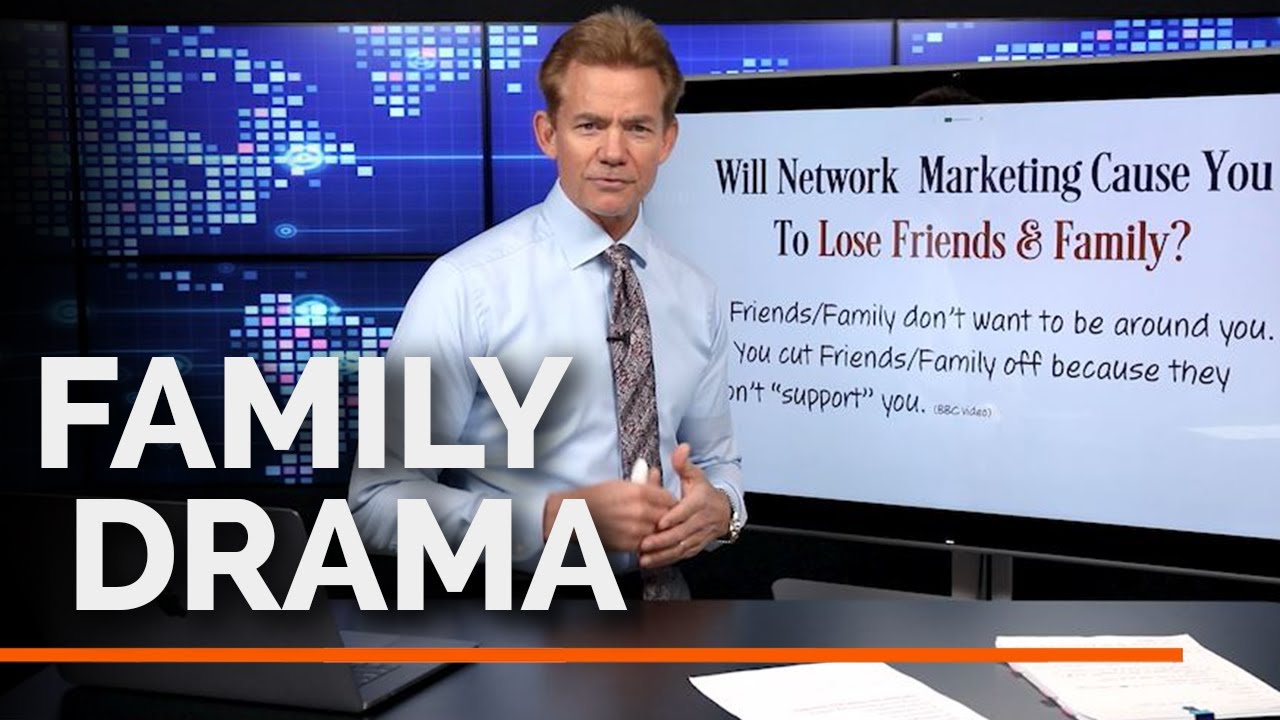
Will Network Marketing Cause Family Drama and Drive Friends Away?
Have you heard horror stories about network marketing family drama? What about friends leaving because of MLM?
You’re probably wondering if there’s any truth to them. Well, that depends. There are two main ways it could happen:
- Friends and family don’t want to be around you.
- You cut your friends and family off because they don’t support you.
I had the idea for this topic after watching a BBC video on network marketing and MLM. Of course, they used all the usual tactics to discredit it. I’ve dealt with most of those in my videos. But the BBC also touched on the potential for network marketing family drama and the friendships MLM can destroy.
Today, we’re going to dive a little deeper into that specific accusation.
1. Friends and family don’t want to be around you.
If you get into network marketing, will your friends not want to be around you anymore? Will it cause the dreaded “network marketing family drama?”
I made a video about network marketing success. In it, I talked about why some people earn millions in network marketing and some don’t. I used this graphic to help explain it:
[GRAPHIC]
Now, this chart isn’t unique to network marketing at all. This applies to any business, any sales position, or to guy working at the front desk at a restaurant. If anybody lacks these skills, their work is going to suffer.
Not everyone is going to naturally have what it takes to succeed at these things. It takes training to improve—and a lot of people don’t bother with the training. In network marketing, your sponsor might be in such a hurry to get you engaged that they don’t give you the guidance on how to communicate effectively.
I’ve given each person on the graph a grad from F to A, just like students. The worst is an F student, of course. That’s someone who’s untrained and truly terrible at communication.
- They’re unprofessional in communicating about their MLM business.
- They damage their relationships.
- They don’t know what they’re talking about.
- They state outright falsehoods and make unreasonable claims about products and potential income.
What we’re talking about here is spam. Whether it’s within network marketing or not, unwanted communication is spam. No one likes spam.
We’ve all been around that person who won’t shut up about their religion or their political views or whatever other crusade they’re on. It’s just as irritating when someone with a network marketing business is raving about their products to an audience that just doesn’t care. That person isn’t going to get very far.
Next, we have the mediocre marketer. That’s the D grade. They may not be quite as bad as the F student, but they aren’t much better.
- They’re barely more professional.
- They nag, thereby harming relationships.
- They complain and provoke others through rudeness.
- They make things awkward for everyone around them.
This is the person who keeps on pestering. They’re the ones always sneering and saying, “What, are you going to stay at your standard job? J.O.B. —that’s just a Journey of the Broke. Blah, blah, blah…”
That sort of approach puts a lot of strain on relationships. It’s utterly unprofessional.
But it doesn’t have to be that way. Throughout my years in network marketing, I haven’t lost any friends. That’s because I was careful not create tension for my friends and family by behaving unprofessionally. In fact, I made sure to always go above and beyond in securing and maintaining healthy relationships. I wasn’t about to let my network marketing business spark any network marketing family drama.
But these F and D marketers are the ones always being interviewed on media like the BBC. They get pushed in front of a camera to play victim—when their network marketing business actually failed because they didn’t seek the proper training and put in the hard work. It creates a false impression about network marketing that many people believe.
2. You cut your friends and family off because they don’t support you.
This can be a pretty heated topic in network marketing. I may draw fire, and that’s okay.
On the BBC, they interviewed an anonymous person. This person said their upline had told them not to remain friends with people who didn’t “support” them. I put the quotes their because in network marketing, the word support can be very vague.
Now, I’m going to give you my view. You’re welcome to look at things however you want. I think this view will intrigue you, though.
Let’s start off by talking about you. Specifically, your life force. When I say life force, I mean you—the real you. You can call it the spirit, the soul, the id, or anything else you like. It’s not just your body; it’s the source of your willpower. It’s the source of your goals and the self discipline you use to reach them.
This life force is all you really have in the long run. One way or another, friends and family can exit your life. But your life force—your soul—always remains.
I want you to imagine something. Let’s just pretend for a second that we’re all free and we’re all equal. Alright? Assuming that, what would give any one person the right to invalidate a decision that you’ve made? If you’re free and you’re equal with them, what right do they have to try to overrule you?
It seems simple enough, but I see the opposite mindset in action everywhere. Some has a political view, and they want to invalidate everyone else’s. Or they have a religious view and try to force it on others. Ultimately, it comes from the assumption that they’re in charge. They see you as their captive and a subservient to them.
But you aren’t their captive. You’re free.
With that in mind, I made another graph. (Can you tell I’m a systematic kind of guy?)
How much is too much?
The question I asked myself is: should you ever distance yourself from a friend or family member? Well, there does have to be a point at which a person would say, “Okay, I’m getting out of this relationship.” I created a chart to help form an idea of where that line might be:
[GRAPHIC]
The center is an average, lukewarm relationship. To the right, things get better. To the left, things get worse. I have three sections on either side, but you could easily make ten delineations in either direction by being more specific. What matters is that there is a delineation.
The Negative Side
Obviously, on the one extreme, we have attempted murder. If someone tried to kill you, would you say, “I don’t want that person in my life?” I would guess so. Even if you had to move somewhere else.
What if they only threatened murder? Would you still want to get away? What about physical abuse? Maybe they punched you or knocked you down.
I’m not going to try to tell you when you should hit the road (or make them to hit the road), I’m just giving you a scale for context.
In the next grid, we have mental abuse.
- They mock you.
- They belittle you.
- They ask, “Have you made that $1 million from MLM yet?”
They’re more subtle, but they’re still out to invalidate your decisions and bend you to their will. They’re trying to subvert you. I call them termites or vampires. They’re trying to erode you from the inside little by little. You’ve welcomed them into your life, but they’re a danger to you in some way. They want to keep you down—or bring you down.
They won’t say that. Oh, no. They’ll say they’re just trying to help you. (But they’re not.)
This can be totally unrelated to network marketing, too. Let’s say you’re going on a diet. This category is the person that’s going to try to pressure you into going out for pizza and beer even though they know you’re dieting. They try to sabotage you.
The next one are the people who criticize you. Not in a constructive or helpful way, either. Compared with the last group, these ones tend to be more open about their motives.
They’ll say things like:
- “Network marketing doesn’t work.”
- “MLM is impossible.”
- “You’re making a big mistake.”
It’s a frontal attack.
In the case of dieting, they’d be the type to say, “Why even bother? You only live once.”
I’ve had somebody actually ask me why in the world I eat healthy. “What’s it going to do? You’re going to suffer your whole life by eating healthy food. Then what? Maybe you get an extra two years on your life when you’re 70.”
In other words, “Don’t make any efforts to improve yourself. Just let yourself go.” It’s a little better than the last group, because at least with this, you know who your enemy is. But it isn’t good for you, that’s for sure.
The Positive Side
Now we come to the lighter side of things. First off, we have the sort of friend who encourages you. “You’re great at whatever you do!” That’s what my mom told me when I started my network marketing business. My dad and sister were more hesitant. (I’m thankful I didn’t have to deal with any real network marketing family drama, though.)
If you’re on a diet, you’d hear, “Awesome! Keep it up!” This friend encourages you and wants you to succeed. Maybe they take the bread off the table so you aren’t tempted.
The next person inspires you. They’re very interested in what you’re doing. “How’s the diet going? I did the same thing three years ago. It’s a great idea.”
They’re excited for you. They show real interest and inspire you to press on.
But the very best are the friends and family who help you outright. With a diet, maybe they send you excellent recipes and give you tips. With network marketing, maybe they tell you about some good places to advertise.
That’s my scale of unhealthy and healthy relationships. The dividing line is: are they making you want to lean into your business and continue building with excitement—or continue on with the diet—or do they make you want to lean backwards and give up?
How do you handle sabotage?
I made a video about the statistics of network marking and your odds of making it. In that video, I mentioned that something like 99.4% of those who try to diet ultimately fail. Why would you focus on that, though? Instead, it would be wise to look at the .6% that succeeded. What did they do differently? Then you can emulate them and hopefully follow their example.
Too often, people use statistics just to try to a manipulate you and keep you from striving for better things. My answer? That’s irrelevant to my decision making process. I ask, “What about that tiny fraction that succeeded? How did they make it work?”
So let’s say that somebody tosses you that classic line about your network marketing business: “Have you made $1 million yet? Ha ha ha!”
You know what I do? I laugh right back at them. I say, “No, I’ve only been in business two weeks.” I’ll end it at that and change the subject. I’m not going to like fight back and start something. Their mockery shouldn’t affect me.
If they persist even then, I’ll ask them what their intentions are. Are you trying to get me to quit my MLM business? Confront them straight out.
Typically, they’ll retreat. “Oh no, no, no man. I’m just joking.”
Then I try to drop the subject and steer us back to a better track. I’m certainly not going to kick the guy out of my life right there. I’m just going to try to keep him from needling me.
“Why lose weight? You only live once.”
“Okay. Maybe you don’t want to go on a diet. I do. Let’s leave it there.”
At a certain point though, if they really won’t give it up, I’m probably not going to want them around. That just isn’t the kind of conditions I want to build a relationship around. If you’re going to constantly invalidate me, maybe we just aren’t compatible. That’s not what friends do.
So when that anonymous man on the BBC report said his upline told him not to remain friends with people who don’t support him, I want to know more. What kind of “support” did he mean?”
It’s really very simple…
I’ve never advised anyone to break any relationships. I’m not going to decide that for someone else. Now, if I know there’s real destructive behavior going on, such as abuse, I might say something. There is a point where it’s obviously bad idea to associate with someone. But even then, it’s still their call.
And it’s all because I believe two things:
- We’re all free.
- We’re all equal.
…And it’s the same reason you should be able to expect support from others when you make a decisions like starting a network marketing business.
So if you want to make sure you don’t lose friends or family, the best thing you can do is be professional and friendly. Then, work to improve yourself all the time so you won’t be a strain to others.
However, if people you know are undermining your efforts, address that. If it becomes enough of an issue, maybe it is a good idea to distance yourself. If you have an unhealthy relationship with someone and you’ve tried and failed to resolve it, it might be best for everyone involved to go your separate ways….
(But that’s going to be very rare—or at least it should be.)
In short, protect your life force—at the end of the day, it’s the heart of you.
If you liked this article, please check out my website. You can find plenty of other articles and videos to help you out. My Youtube channel will give you some great information as well.
Best of luck in the wild world of network marketing—family drama free, no less.